Friday, August 18, 2006
Existentialism and Postmodernism - John Piper
Existentialism Was the Air We Breathed
"The passion not to miss the essence of life, not to waste it, intensified
in college—the tumultuous late sixties. There were strong
reasons for this, reasons that go well beyond the inner turmoil of
one boy coming of age. “Essence” was under assault almost
everywhere. Existentialism was the air we breathed. And the
meaning of existentialism was that “existence precedes essence.”
That is, first you exist and then, by existing, you create your
essence. You make your essence by freely choosing to be what you
will be. There is no essence outside you to pursue or conform to.
Call it “God” or “Meaning” or “Purpose”—it is not there until
you create it by your own courageous existence. (If you furrow
your brow and think, “This sounds strangely like our own day
and what we call postmodernism,” don’t be surprised. There is
nothing new under the sun. There are only endless repackagings.)"
(Emphasis Added)
John Piper
"Don’t Waste Your Life" , pg. 14 & 15


Monday, August 14, 2006
Who Needs Biblical Theology?
A commenter left in response to my post (back in January) about Don Miller’s book, “Blue Like Jazz”, a statement that Miller “was not opposing reformed theology, but was just not thinking of it.” What?! How can one set out to write a book discussing the Christian faith and not think about theology? Yes, I know that he was supposedly setting out to write a book, taking a “non-religious” approach to describe the Christian faith. But in the process of writing a book under the auspice of a “non-religious” approach, the tendency is to carelessly present a particular view of God and our relationship with Him. It is utterly impossible to accurately describe the Christian faith without expounding the knowledge of God based upon the truth of Scripture. I am all for removing any man-made “baggage” that may muddy the message, but you cannot minimize the use of Scripture (which is apparently Miller’s approach with this book), and with any degree of precision, tell people how to have a saving relationship with Jesus Christ. I am not talking about one being an expert theologian, but at least have a good grasp of the theological implications of the subject matter they are addressing. Perhaps Miller has good intentions, but to ignore sound biblical theology in an apparent attempt to appeal to the masses is extremely dangerous. It is this attitude that causes the greatest concern with the emerging “church”. To leave out Scripture in an attempt to keep from offending people is an erroneous premise for evangelism. People can only be saved as a result of hearing the truth. If people are offended by the truth, then it is obvious that God has not opened their eyes to the truth. To water down or avoid the truth does nothing more than present a skewed view of the Gospel.
When someone sets out to write or speak, and whose audience is the general public, they have identified themselves as a teacher of sorts. Like it or not. This carries with it a certain level of responsibility. And that responsibility is to accurately teach, to the best of one’s ability, whatever the subject being addressed. To do otherwise is to engage in a recklessness that does great disservice to the hearers and grieves God. It is this mentality that creates an environment ripe for heresy.
Regardless of whether one is officially in a teaching position or not, all believers should gain a solid grasp of basic theology. Theology by its very definition is the study of God and all believers should be seeking a deeper knowledge of God. This is how we develop intimacy with God and ultimately directs our thoughts and how we conduct our life. In a sense, everyone embraces a theological view whether they realize it or not. The question is whether it is true biblical theology or if it is a false, erroneous theology. A proper understanding of God is crucial in the life of a believer.
I came across these notes on the “9 Marks” website on the importance of theology. Here is an excerpt from this document highlighting some important points concerning biblical theology.
- The operating assumptions for biblical theology are therefore that the main theological linesof Scripture's story are discernable, and that we are called by God to learn, teach, and apply them in our churches.
- These assumptions are so essential to the fabric of Christianity that, if we refuse to grant them, we call into question the functional validity of God's self-revelation, and we replace the authority of God's Word with our own finite and fallen reason.
- Some of the more unpopular biblical doctrines (divine sovereignty, election) are often either explained away so as to remove all inherent offensiveness, or ignored all together by many pastors, thus obscuring the Bible’s clarity in the eyes of God’s people.
- When we obscure the Bible’s clarity in this way, we erode the confidence of budding
Christians in their own Spirit-given capability to profit from Scripture by themselves. - This corporate erosion of the confidence of God’s people in the clarity of God’s Word
weakens the local church by weakening the community’s faith in the life-giving, sanctifying power of God’s Word. - Obscuring Scripture’s clarity through the attempted removal of its inherent offensiveness also blurs the intentionally distinct lines between the theology of the evangelical church and the various theologies of the world.
- So in asking whether our theology is biblical, we’re really asking whether the theology we teach either clarifies or obscures the plain meaning of Scripture for the people of God.
- We’re also asking whether the theology we teach helps distinguish the true gospel from
other popular but less faithful teaching (cf. Gal 1:6-9). - When pastors explain away or ignore some of the Bible's less popular doctrines, the
church's fidelity to Scripture is at least partially compromised. - So in asking whether our theology is biblical, we’re also asking whether or not our
perception and proclamation of the main lines of the biblical story are faithful to what the Bible actually and objectively teaches, especially on unpopular doctrines. - Martin Luther said that if we preach everything but that one point of doctrine which in our time and culture are unpopular, we flee from the very battle we are called to fight.
Here is a link to the whole section on biblical theology at 9 Marks with some sermons that you can listen to. This is a great resource.
Friday, August 11, 2006
The Importance of Being “Truth-Driven”
“Our concern with truth is an inevitable expression of our concern with God. If God exists then he is the measure of all things, and what he thinks about all things is the measure of what we should think. Not to care about truth is not to care about God. To love God passionately is to love truth passionately. Being God-centered in life means being truth-driven in ministry. What is not true is not of God. What is false is anti-God. Indifference to the truth is indifference to the mind of God. Pretense is rebellion against reality and what makes reality is God. Our concern with truth is simply an echo of our concern with God.”
John Piper
Baptist General Conference Annual Meeting
July 1 & 2, 1993
Des Moines, Iowa
John Piper
Baptist General Conference Annual Meeting
July 1 & 2, 1993
Des Moines, Iowa
Tuesday, August 08, 2006
An Encouragement for Proclaiming the Truth.
I ran across this post at Slice of Laodicea. Apparently, a man by the name of Alex Leung from Toronto has realized the error in the emerging "church". He has offered an apology on his website for giving out copies of Rob Bell's book, "Velvet Elvis". Here is what he had to say about Bell:
I want to apologize here to those whom have received Rob Bell’s “Velvet Elvis” as a gift from me. After further investigation and research into the contents of this book about “repainting our faith”, I have come to understand that it follows very directly to the ways of the emergent cult. While Bell’s Nooma videos appear to contain good Spiritual food and is seemingly a great medium to reach today’s postmondern culture, his written beliefs about our faith is quite far fetched and reveal that he is one deviation from orthodoxy and the truth of the Gospel of our LORD Jesus Christ. You should not have to or even desire to read such heresy, and I would gladly accept it back. (EDITED: August 6, 2006)
It is very encouraging when you see someone turn away from theological error rather than embrace it! This should come as encouragement to those of us who point out doctrinal error, that there are some who are reached with the truth.
I want to apologize here to those whom have received Rob Bell’s “Velvet Elvis” as a gift from me. After further investigation and research into the contents of this book about “repainting our faith”, I have come to understand that it follows very directly to the ways of the emergent cult. While Bell’s Nooma videos appear to contain good Spiritual food and is seemingly a great medium to reach today’s postmondern culture, his written beliefs about our faith is quite far fetched and reveal that he is one deviation from orthodoxy and the truth of the Gospel of our LORD Jesus Christ. You should not have to or even desire to read such heresy, and I would gladly accept it back. (EDITED: August 6, 2006)
It is very encouraging when you see someone turn away from theological error rather than embrace it! This should come as encouragement to those of us who point out doctrinal error, that there are some who are reached with the truth.
Friday, August 04, 2006
A Church for “Goths”
These days it seems that it is getting harder and harder to parody the church. Phil Johnson did this parody below of a “Biblezine” for Goth girls awhile back.
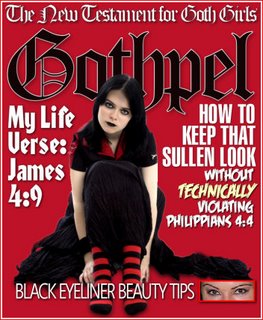
But I came across something that is definitely not a laughing matter at all. On the “Emergent Village” website, I discovered an affiliated Emergent church, The Church of the Apostles in Seattle, WA, that sponsors a Gothic Mass catering to those in the Gothic culture. There is an interview between the pastor, Karen Ward and Tony Jones posted there discussing the history of the church and their form of worship (this discussion of their worship is about half way through the interview). Karen Ward is on the Emergent Village Board of Directors.
This Gothic mass is called “Sanctorum Mass” (Sanctorum being Latin for “holy place”). The whole thing takes place using a gothic theme that brings to mind something of more satanic origins that anything holy. There is a link provided to the “Sanctorum My Space”; yes, THAT infamous MySpace that has come under fire in the news for becoming a venue for sexual predators, and leaving objectionable content open to be viewed by anyone. The initial page after clicking on the link is bad enough, with images that give an eerie feeling of something of more satanic origins. But when you click on some of the personal “spaces” of the people who are participants in this so-called “dark beautiful mass”, it really reveals the true nature of those who are regularly involved. The content is shocking and disgusting with extremely sinister images. A part of me wanted to provide the direct links to the "Sanctorum My Space" here, but given the content of the material posted there, I simply could not do it. Yes, it is that bad! Be forewarned; the link to MySpace contains material that is very offensive and really inappropriate for young viewers.
These personal spaces on MySpace are littered with sexually suggestive (often explicit) graphic images, laced with profanity, music playing in the background containing vile profanity and themes with satanic overtones. The content is disturbing and outright perverse.
What is frightening is that people may stumble across this site, especially young people who could even be given the link from someone in the church youth group. Many popular books written by those in the emerging church movement even contain advertisements and endorsements for the Emergent Village website, including Donald Miller’s book, “Blue Like Jazz”. Pay close attention to what is being handed out in your church, and be particularly watchful of material that may be given to your kids even from someone in your church’s youth group. Closely monitor what your kids may be accessing on the internet. Most important, make sure they understand what they believe and develop discernment between truth and error. Instill in them a love and reverence for God and His Word and a desire for holiness.
Thursday, August 03, 2006
Emergent’s Influence on the Broader “emerging” Movement
There are those who claim that the broader “emerging church” is distinctly different from the official organization “Emergent”, and not heavily influenced by Emergent. However, the quote below reveals how influential they really are. I realize that there may be some in the broader emerging movement who may not follow the radical extreme and theological error of McLaren and company, but for the most part, it is HEAVILY influenced by the theological thought of Emergent, the organization.
“By 2001, we had formed an organization around our friendship, known as Emergent, as a means of inviting more people into the conversation. Along with us, the “emerging church” movement has been growing, and we in Emergent Village endeavor to fund the theological imaginations and spiritual lives of all who consider themselves a part of this broader movement.”(Emphasis Added)
- Quote from the Emergent Village website on the “About” page, under "Organization".
It is also interesting to note the list of “Affiliates” that support Emergent Village. These are the organizations that stand in partnership with and support Emergent.
From the Emergent Village website from their informational page under "support":
“Below is a list of organizations who have voiced their support of Emergent Village and supported us financially in 2006. They are our “organizational friends,” if you will.”
- Abingdon Press
- Amahoro
- Baker Publishing House
- Cooperative Baptist Fellowship
- Gordon-Conwell Theological Seminary
- InterVarsity Press
- Jossey-Bass Publishers
- The Journal of Student Ministries
- Journey Community Church, Dallas
- NCCUSA Faith & Order Commission
- Wesley Theological Seminary
- Zondervan Publishing House
Tuesday, August 01, 2006
A Warning Concerning Lukewarmness
Excerpt from:
"An Earnest Warning about Lukewarmness"
Delivered on July 26th, 1874 by C. H. SPURGEON
"Unto the angel of the church of the Laodiceans write; These things saith the Amen, the faithful and true witness, the beginning of the creation of God; I know thy works, that thou art neither cold nor hot: I would thou wert cold or hot. So then because thou art lukewarm, and neither cold nor hot, I will spue thee out of my mouth. Because thou sayest, I am rich, and increased with goods, and have need of nothing; and knowest not that thou art wretched, and miserable, and poor, and blind, and naked: I counsel thee to buy of me gold tried in the fire, that thou mayest be rich; and white raiment, that thou mayest be clothed, and [that] the shame of thy nakedness do not appear; and anoint thine eyes with eyesalve, that thou mayest see. As many as I love, I rebuke and chasten: be zealous therefore, and repent. Behold, I stand at the door, and knock: if any man hear my voice, and open the door, I will come in to him, and will sup with him, and he with me. To him that overcometh will I grant to sit with me in my throne, even as I also overcame, and am set down with my Father in his throne."
--Rev. 3:14-21
I. My first point will be THE STATE INTO WHICH CHURCHES ARE VERY APT TO FALL. A church may fall into a condition far other than that for which it has a repute. It may be famous for zeal and yet be lethargic. The address of our Lord begins, "I know thy works," as much as to say, "Nobody else knows you. Men think better of you than you deserve. You do not know yourselves, you think your works to be excellent; but I know them to be very different." Jesus views with searching eyes all the works of his church. The public can only read reports, but Jesus sees for himself. He knows what is done, and how it is done, and why it is done. He judges a church not merely by her external activities, but by her internal pieties; he searches the heart, and tries the reins of the children of men. He is not deceived by glitter; he tests all things, and values only that gold which will endure the fire. Our opinion of ourselves and Christ's opinion of us may be very different, and it is a very sad thing when it is so. It will be melancholy indeed if we stand out as a church notable for earnestness and distinguished for success, and yet are not really fervent in spirit, or eager in soul-winning. A lack of vital energy where there seems to be most strength put forth, a lack of real love to Jesus where apparently there is the greatest devotedness to him, are sad signs of fearful degeneracy. Churches are very apt to put the best goods into the window, very apt to make a fair show in the flesh, and like men of the world, they try to make a fine figure upon a very slender estate. Great reputations have often but slender foundations, and lovers of the truth lament that it should be so. Not only is it true of churches, but of every one of us as individuals, that often our reputation is in advance of our deserts. Men often live on their former credit, and trade upon their past characters, having still a name to live, though they are indeed dead. To be slandered is a dire affliction, but it is, upon the whole, a less evil than to be thought better than we are; in the one case we have a promise to comfort us, in the second we are in danger of self-conceit. I speak as unto wise men, judge ye how far this may apply to us.
The condition described in our text is, secondly, one of mournful indifference and carelessness. They were not cold, but they were not hot; they were not infidels, yet they were not earnest believers; they did not oppose the gospel, neither did they defend it; they were not working mischief, neither were they doing any great good; they were not disreputable in moral character, but they were not distinguished for holiness; they were not irreligious, but they were not enthusiastic in piety nor eminent for zeal: they were what the world calls "Moderates," they were of the Broad-church school, they were neither bigots nor Puritans, they were prudent and avoided fanaticism, respectable and averse to excitement.
I’m Back!
I am back and ready to resume blogging! We had a great time on vacation, though it always seems to be too short. Beach vacations are generally relaxing. The only bad thing was the drive down to Myrtle Beach, taking a whopping 23 hours total due to the high volume of traffic. We took a different route down to South Carolina than we normally take, passing through Washington D.C. and stopping off at Richmond Va. to visit with some friends. We anticipated arriving in Richmond by 3 or 4 PM the day we left home, but due to getting caught in extremely heavy traffic around Washington D.C., we did not arrive until around 7:30 that evening, making our visit rather short. I do not recommend going anywhere near D.C., especially anytime after 3 PM on a Friday when rush hour starts if you can avoid it. It took a total of 13 hours to arrive at Richmond, VA. We got on the road the next day headed for Myrtle Beach and ran into heavy traffic on I-95. After sitting for quite some time in bumper to bumper traffic, we finally got off at the nearest exit and took some back roads to get to the coast and made our way to finally arrive at Myrtle Beach around 7:30 PM. The trip from Richmond to Myrtle Beach was an additional 10 hours and who knows how much longer the trip would have been had we not gotten off of I-95. Not sure if traffic is always that heavy on I-95, but after that experience, I would recommend an alternate route and avoid I-95 if possible. The trip back went much smoother, taking an alternate route, and although it seemed to slow us down a bit passing through some small towns, we still made the trip back from Myrtle Beach in only 13 hours. Although we would have liked to stay longer, it is always nice to be home again.
Thursday, July 20, 2006
I'll Be Back!

I will be taking a break from blogging starting today and will be returning Tuesday, August 1. Taking some time to spend with my wife and kids and get away for awhile. I have several posts that I have started to write but have not had the time to finish. I have been busy getting ready for vacation, mainly getting our Ford mini-van ready for travel, making some necessary repairs and cleaning it up. It simply amazes me that we are approaching the 100,000 mile mark, and the vehicle seems to have a self-destruct switch; everything seems to be going wrong. This is the first vehicle that I have had to replace a steering rack and I generally drive my vehicles to well over 100,000 miles. What is frustrating is that just after the rack was replaced, a fuel injector failed. But I guess it is better for this to happen before we get on the road and that I am able to make many of the repairs myself (with the exception of the rack and fuel injector, which combined totaled almost $1400), saving us several hundred dollars. Hopefully this will be the last round of repairs and be OK for awhile, especially while we are traveling out of town.
Wednesday, July 19, 2006
Feeling God But Not Knowing God
“In Christian music we are missing the key pillar, the cornerstone, which the other two rely upon - sound doctrine! There has already occurred a much needed return to praise and worship in the church and we’ve observed that across the board in evangelicalism. There has also been, in recent years noted scandals with both Televangelists and Christian artists, bringing a heightened call for more personal integrity, holiness and ecclesiastical accountability.[6] Though we have not arrived in those areas, we are on the path, nevertheless, the Achilles heel of our industry is the blatant absence of sound biblical theology which has effected every level of Christian music. This is most evident in it’s message. Christian music, originally called Jesus Music that once fearlessly sang about the gospel, now sings of a Christ-less, watered-down, pabulum-based, positive alternative, aura-fluff cream of wheat, mush-kind-of-syrupy God-as-my-girlfriend thing. There is an obvious reason this has taken place: artists primarily feel; theologians primarily think. We need artists who will balance their zeal with knowledge[7] to invest their lives in the daily discipline of Bible study, and then, to write with the fire, passion and enthusiasm which that study has illumined to communicate the glorious language of the church - the holy Word of God! Until this occurs, we are guilty of sentencing a generation of Christians to simply “feel” their God, rather than to know their God! In the early days of my own music ministry I wrote songs that neither represented good music or precise theology. It is out of the crucible of those experiences that God convicted me, which drives me to speak passionately to these issues.” (Emphasis Mine)
-Steve Camp “What Makes Music… Christianly”
I certainly appreciate Steve Camp and his sound biblical theology and the fact that he seeks to make his music line up with Scripture. We certainly need many more like him in Christian music. Lack of sound doctrine is a key issue with so-called Christian music today, and the reason that so many people involved in music tend to really irritate me. They tend to be free spirits who don’t want to be encumbered with all that doctrine and theology stuff, claiming that they just want to “looove Jesus”. But loving Jesus means that we also adhere to the truth proclaimed through the Word of God.
“6And this is love, that we walk according to His commandments This is the commandment, just as you have heard from the beginning, that you should walk in it.
(2 John 1:6, NASB)
“13Retain the standard of sound words which you have heard from me, in the faith and love which are in Christ Jesus.
14Guard, through the Holy Spirit who dwells in us, the treasure which has been entrusted to you.” (2 Timothy 1:13-14, NASB)
15 Be diligent to present yourself approved to God, a worker who does not need to be ashamed, rightly dividing the word of truth. (2 Timothy 2:15, NKJV)
But what about love? If we are truly adhering to God’s truth, then we will be expressing love toward one another. It should go hand in hand with doctrinal truth. The bottom line is that if we love Jesus, we will adhere to his truth. God is to be worshipped in both spirit and in truth.
“23"But an hour is coming, and now is, when the true worshipers will worship the Father in spirit and truth; for such people the Father seeks to be His worshipers.
24"God is spirit, and those who worship Him must worship in spirit and truth." “
(John 4:23-24, NASB)
When people engage in a ministry such as Christian music, they are expressing their thoughts and views about God. They are really communicating a message concerning God and it is therefore imperative that the message be rooted and grounded in Scriptural truth. Otherwise the message is vague and can project a distorted view of God. If the message of Christ is to reach people’s hearts, it is of utmost importance that those involved in music be sure the message in their music is proclaimed with biblical clarity.
I will also add that this is not an issue isolated to music, but also the church in general. It has become the bane of evangelicalism, where we are focusing on creating experience and emphasizing emotion and feeling above the importance of Scriptural truth. There is nothing wrong with engaging the emotions when worshipping God and that should be encouraged. But more important is grounding our emotion and feeling in objective biblical truth. I fear that much of what has taken place in the church today is an overcorrection to the error of discounting feeling and emotion in worship. And this unfortunate trend seems to be increasing in intensity. More and more Christian leaders are adapting to the spirit of this age and cooking up an approach to ministry to suit man’s carnal nature.
“The church of the 21st century... focuses worship primarily on what a person experiences about God instead of what a person learns about God. This trend is confirmed by the growing unchurched, biblically illiterate, ethically void, population growing up outside of the influence of Christianity. Their basic need is to experience the presence (immanence) of God, not to be educated about God or the church. Emphasis is placed on stirring the heart and emotions, not educating the head.”(Emphasis Added)
“The Church of the 21st Century”
By Bill Easum
While Bill Easum would not necessarily be identified with the emerging “church” movement, he has been heavily influenced by postmodern authors such as Leonard Sweet. (read this article here, second to last paragraph) Easum is a church consultant and his thinking is very influential in many churches.
I am in no way making an excuse for the seemingly dead, lifeless approach that many churches got caught up in and I do not want to see an overreaction in the opposite direction as well. We do not want to merely engage in a cold, dead orthodoxy. But to make the error of discounting the importance of sound doctrine as an alternative is a grievous mistake, with devastating spiritual consequences.
-Steve Camp “What Makes Music… Christianly”
I certainly appreciate Steve Camp and his sound biblical theology and the fact that he seeks to make his music line up with Scripture. We certainly need many more like him in Christian music. Lack of sound doctrine is a key issue with so-called Christian music today, and the reason that so many people involved in music tend to really irritate me. They tend to be free spirits who don’t want to be encumbered with all that doctrine and theology stuff, claiming that they just want to “looove Jesus”. But loving Jesus means that we also adhere to the truth proclaimed through the Word of God.
“6And this is love, that we walk according to His commandments This is the commandment, just as you have heard from the beginning, that you should walk in it.
(2 John 1:6, NASB)
“13Retain the standard of sound words which you have heard from me, in the faith and love which are in Christ Jesus.
14Guard, through the Holy Spirit who dwells in us, the treasure which has been entrusted to you.” (2 Timothy 1:13-14, NASB)
15 Be diligent to present yourself approved to God, a worker who does not need to be ashamed, rightly dividing the word of truth. (2 Timothy 2:15, NKJV)
But what about love? If we are truly adhering to God’s truth, then we will be expressing love toward one another. It should go hand in hand with doctrinal truth. The bottom line is that if we love Jesus, we will adhere to his truth. God is to be worshipped in both spirit and in truth.
“23"But an hour is coming, and now is, when the true worshipers will worship the Father in spirit and truth; for such people the Father seeks to be His worshipers.
24"God is spirit, and those who worship Him must worship in spirit and truth." “
(John 4:23-24, NASB)
When people engage in a ministry such as Christian music, they are expressing their thoughts and views about God. They are really communicating a message concerning God and it is therefore imperative that the message be rooted and grounded in Scriptural truth. Otherwise the message is vague and can project a distorted view of God. If the message of Christ is to reach people’s hearts, it is of utmost importance that those involved in music be sure the message in their music is proclaimed with biblical clarity.
I will also add that this is not an issue isolated to music, but also the church in general. It has become the bane of evangelicalism, where we are focusing on creating experience and emphasizing emotion and feeling above the importance of Scriptural truth. There is nothing wrong with engaging the emotions when worshipping God and that should be encouraged. But more important is grounding our emotion and feeling in objective biblical truth. I fear that much of what has taken place in the church today is an overcorrection to the error of discounting feeling and emotion in worship. And this unfortunate trend seems to be increasing in intensity. More and more Christian leaders are adapting to the spirit of this age and cooking up an approach to ministry to suit man’s carnal nature.
“The church of the 21st century... focuses worship primarily on what a person experiences about God instead of what a person learns about God. This trend is confirmed by the growing unchurched, biblically illiterate, ethically void, population growing up outside of the influence of Christianity. Their basic need is to experience the presence (immanence) of God, not to be educated about God or the church. Emphasis is placed on stirring the heart and emotions, not educating the head.”(Emphasis Added)
“The Church of the 21st Century”
By Bill Easum
While Bill Easum would not necessarily be identified with the emerging “church” movement, he has been heavily influenced by postmodern authors such as Leonard Sweet. (read this article here, second to last paragraph) Easum is a church consultant and his thinking is very influential in many churches.
I am in no way making an excuse for the seemingly dead, lifeless approach that many churches got caught up in and I do not want to see an overreaction in the opposite direction as well. We do not want to merely engage in a cold, dead orthodoxy. But to make the error of discounting the importance of sound doctrine as an alternative is a grievous mistake, with devastating spiritual consequences.
Tuesday, July 18, 2006
More Information on Chuck Smith’s Position
Thanks to Carla who left this link in a comment to my previous post, “In All Fairness”. Roger Oakland has provided some comments expanding on Chuck’s position on his website, “Understand the Times”.
Wednesday, July 12, 2006
In All Fairness.
I want to take a moment to clarify something. Not all of those who embrace an Arminian theological bent are in favor of the pragmatic, seeker-sensitive approach to ministry. Some are even very outspoken against such strategies. However, I still believe that Arminianism by its very nature has a tendency to lend itself to such thinking. When you examine the underlying principles embraced by the pragmatic seeker-sensitive approach (I believe you can also include much of the “emerging church” with this pragmatism as well), the synergistic soteriological views tend toward the “end-justifies-the-means” mentality. I also believe a careful examination of church history shows that the synergistic view of salvation has a generally negative effect on the church. I am also convinced that Scripture teaches a monergistic view of salvation.
But there are some like Chuck Smith Sr., who has recently taken a strong stand against some of these approaches to ministry. I recently wrote a post concerning the letter that he addressed to the Calvary Chapel churches refuting the error of the emerging “church”. But apparently Chuck has also addressed the Purpose Driven frenzy as well. A notice published on the Calvary Distribution website (their ministry resource website) indicates that the Purpose Driven resources are being discontinued.
“The teaching and positions of Rick Warren have come into conflict with us as Calvary Chapel. Pastor Chuck has directed us to discontinue this product effective immediately. The following items are now longer available through Calvary Distribution”
You will also notice that Chuck’s book “When Storms Come” is being recalled “Due to issues with content and packaging”. These issues have to do with apparent tampering with the text to include language pertaining to contemplative worship and references to mystics, something that Chuck Smith never originally wrote.
“The title When Storms Come by Pastor Chuck Smith from World Publishing is being recalled, effective immediately. Due to issues with content and packaging, this title has been set to out of print.”
Again, I may disagree with certain theological views, such as Chuck Sr’s Arminian bent, but I certainly appreciate his stand on these issues, since this is not going to be a popular stand to take. I hope and pray that he continues to keep up the fight because it appears that the Calvary Chapel movement may be reaching a crossroad.
But there are some like Chuck Smith Sr., who has recently taken a strong stand against some of these approaches to ministry. I recently wrote a post concerning the letter that he addressed to the Calvary Chapel churches refuting the error of the emerging “church”. But apparently Chuck has also addressed the Purpose Driven frenzy as well. A notice published on the Calvary Distribution website (their ministry resource website) indicates that the Purpose Driven resources are being discontinued.
“The teaching and positions of Rick Warren have come into conflict with us as Calvary Chapel. Pastor Chuck has directed us to discontinue this product effective immediately. The following items are now longer available through Calvary Distribution”
You will also notice that Chuck’s book “When Storms Come” is being recalled “Due to issues with content and packaging”. These issues have to do with apparent tampering with the text to include language pertaining to contemplative worship and references to mystics, something that Chuck Smith never originally wrote.
“The title When Storms Come by Pastor Chuck Smith from World Publishing is being recalled, effective immediately. Due to issues with content and packaging, this title has been set to out of print.”
Again, I may disagree with certain theological views, such as Chuck Sr’s Arminian bent, but I certainly appreciate his stand on these issues, since this is not going to be a popular stand to take. I hope and pray that he continues to keep up the fight because it appears that the Calvary Chapel movement may be reaching a crossroad.
Saturday, July 08, 2006
What is Guiding Your Thoughts?
Doug over at Godward Thoughts recently posted a quote by John Piper, where Piper made the statement that “It will be a superficial, weak, carnal, disunited church; where people are playing fast and loose with their Bibles.” This is sadly the case with a growing majority of evangelical churches today. Piper goes on to say that people are turning to the world and observing what is commended by the world’s standard, but they barely give any time to look to the Word of God for their guidance. Consequently, the church succumbs to fleshly wisdom rather than to guidance from God’s truth.
This was a major issue with the Corinthians, and the reason Paul wrote in 1 Corinthians 3 that they were unable to tolerate the solid meat of God’s truth. They were not truly feasting on God’s Word and could only tolerate the very basic “milk”, like an infant. As a result, their actions were not guided by the Word of God, but by the works of the flesh. This resulted in a very immature, carnal congregation laden with sin. When people are not immersing themselves in God’s truth, spiritual growth is severely hindered, resulting in a weak, sickly congregation.
“1But I, brothers, could not address you as spiritual people, but as people of the flesh, as infants in Christ. 2I fed you with milk, not solid food, for you were not ready for it. And even now you are not yet ready, 3for you are still of the flesh. For while there is jealousy and strife among you, are you not of the flesh and behaving only in a human way?” (1 Corinthians 3:1-3, ESV)
What is the remedy? Romans 12:2 tells us that we should be “transformed by the renewing” of our mind.
“1I appeal to you therefore, brothers, by the mercies of God, to present your bodies as a living sacrifice, holy and acceptable to God, which is your spiritual worship. 2Do not be conformed to this world, but be transformed by the renewal of your mind, that by testing you may discern what is the will of God, what is good and acceptable and perfect.” (Romans 12:1-2, ESV)
The word “transformed” is translated from the Greek word, “metamorphoo”, which means to be changed into another form and is the same word used in Matthew 17:2 to describe the appearance of Christ in the transfiguration. We must be transformed, meaning that we go through a “metamorphosis”, resulting in a change in our outward actions and appearance. Our thoughts must be changed, being replaced with God’s thoughts since our actions are guided by our thoughts. Our hearts cannot be changed without meditating on God’s truth. If our minds are contstantly being filled with the world’s wisdom and are not being renewed with God’s wisdom, our actions are going to be governed by the impulses of our flesh. Our actions which include our emotions and feelings must be brought under the control of the Holy Spirit through the Word of God.
Only when we are meditating on the Word of God and filtering everything thrown our way through God’s truth, are we able to test and discern what God’s will is. It is only when we are walking or patterning our life after God’s Word that we are going to be fulfilling God’s will. It is the Word of God that lights our path and guides us in our life.
“Your word is a lamp to my feet and a light to my path.” (Psalm 119:105, ESV)
This was a major issue with the Corinthians, and the reason Paul wrote in 1 Corinthians 3 that they were unable to tolerate the solid meat of God’s truth. They were not truly feasting on God’s Word and could only tolerate the very basic “milk”, like an infant. As a result, their actions were not guided by the Word of God, but by the works of the flesh. This resulted in a very immature, carnal congregation laden with sin. When people are not immersing themselves in God’s truth, spiritual growth is severely hindered, resulting in a weak, sickly congregation.
“1But I, brothers, could not address you as spiritual people, but as people of the flesh, as infants in Christ. 2I fed you with milk, not solid food, for you were not ready for it. And even now you are not yet ready, 3for you are still of the flesh. For while there is jealousy and strife among you, are you not of the flesh and behaving only in a human way?” (1 Corinthians 3:1-3, ESV)
What is the remedy? Romans 12:2 tells us that we should be “transformed by the renewing” of our mind.
“1I appeal to you therefore, brothers, by the mercies of God, to present your bodies as a living sacrifice, holy and acceptable to God, which is your spiritual worship. 2Do not be conformed to this world, but be transformed by the renewal of your mind, that by testing you may discern what is the will of God, what is good and acceptable and perfect.” (Romans 12:1-2, ESV)
The word “transformed” is translated from the Greek word, “metamorphoo”, which means to be changed into another form and is the same word used in Matthew 17:2 to describe the appearance of Christ in the transfiguration. We must be transformed, meaning that we go through a “metamorphosis”, resulting in a change in our outward actions and appearance. Our thoughts must be changed, being replaced with God’s thoughts since our actions are guided by our thoughts. Our hearts cannot be changed without meditating on God’s truth. If our minds are contstantly being filled with the world’s wisdom and are not being renewed with God’s wisdom, our actions are going to be governed by the impulses of our flesh. Our actions which include our emotions and feelings must be brought under the control of the Holy Spirit through the Word of God.
Only when we are meditating on the Word of God and filtering everything thrown our way through God’s truth, are we able to test and discern what God’s will is. It is only when we are walking or patterning our life after God’s Word that we are going to be fulfilling God’s will. It is the Word of God that lights our path and guides us in our life.
“Your word is a lamp to my feet and a light to my path.” (Psalm 119:105, ESV)
Monday, July 03, 2006
Luther on Salvation and "Free-will"

Excerpt from the “Bondage of the Will”
by Martin Luther
1525 A.D.
The comfort of knowing that salvation does not depend on free-will
"I frankly confess that, for myself, even if it could be, I should not want free-will to be given to me, nor anything to be left in my own hands to enable me to endeavor after salvation; not merely because in face of so many dangers, and adversities, and assaults of devils, I could not stand my ground and hold fast my free-will (for one devil is stronger than all men, and on these terms no man could be saved); but because, even were there no dangers, adversities, or devils, I should still be forced to labor with no guarantee of success, and to beat my fists at the air. If I lived and worked to all eternity, my conscience would never reach comfortable certainty as to how much it must do to satisfy God. Whatever work I had done, there would still be a nagging doubt as to whether it pleases God, or whether He required something more. The experience of all who seek righteousness by works proves that; and I learned it well enough myself over a period of many years, to my own great hurt. But now that God has taken my salvation out the control of my own will , and put it under the control of His, and promised to save me, not according to my working or running, but according to His own grace and mercy, I have the comfortable certainty that He is faithful and will not lie to me, and that He is also great and powerful, so that no devils or opposition can break Him or pluck me from Him. No one, He says, shall pluck them out of my hand, because my father which gave them me is greater than all [John 10:28-29]. Thus it is that, if not all, yet some, indeed many, are saved; whereas, by the power of free-will none at all could be saved, but every one of us would perish.
Furthermore, I have the comfortable certainty that I please God, not by reason of the merit of my works, but by reason of His merciful favor promised to me; so that, if I work too little, or badly, He does not impute it to me, but with fatherly compassion pardons me and makes me better. This is the glorying of all the saints in their God."
Tuesday, June 27, 2006
The Real Test
Part of the test of whether a prophet was speaking the words of the Lord is whether or not what was prophesied actually comes to pass with 100% accuracy. There was no such thing as a genuine prophecy being 50% accurate or even 99% accurate; pinpoint accuracy was demanded otherwise the prophecy was considered false and to be disregarded.
“18'I will raise up a prophet from among their countrymen like you, and I will put My words in his mouth, and he shall speak to them all that I command him.
19'It shall come about that whoever will not listen to My words which he shall speak in My name, I Myself will require it of him.
20'But the prophet who speaks a word presumptuously in My name which I have not commanded him to speak, or which he speaks in the name of other gods, that prophet shall die.'
21"You may say in your heart, 'How will we know the word which the LORD has not spoken?'
22"When a prophet speaks in the name of the LORD, if the thing does not come about or come true, that is the thing which the LORD has not spoken The prophet has spoken it presumptuously; you shall not be afraid of him.” (Deuteronomy 18:18-22, NASB)
But if we go back a few chapters in Deuteronomy to chapter 13, we find yet another test. In fact, one that is most important of all.
“1"If a prophet or a dreamer of dreams arises among you and gives you a sign or a wonder,
2and the sign or the wonder comes true, concerning which he spoke to you, saying, 'Let us go after other gods (whom you have not known) and let us serve them,'
3you shall not listen to the words of that prophet or that dreamer of dreams; for the LORD your God is testing you to find out if you love the LORD your God with all your heart and with all your soul.
4"You shall follow the LORD your God and fear Him; and you shall keep His commandments, listen to His voice, serve Him, and cling to Him.” (Deuteronomy 13:1-4, NASB)
Even if the sign or wonder comes true, if the prophet teaches anything contrary to God’s revealed truth, it is to be regarded as falsehood and dismissed. In fact, in the Old Testament, the prophet was to be put to death (v. 5) in order to “purge the evil from among you.”
If we would only take heed and use the same discernment today. We should follow the example of the first century Bereans in Acts 17:11 daily examining the Scriptures. We are too enamored with signs and wonders, taking our focus off the Word of God. Everything must pass a theological test.
We have numerous “prophets” today who are proclaiming that God has given them a message, whether it is some word of prophecy or claiming a new way of doing church that God has revealed to them for this generation.
Yet upon closer examination with Scripture, their philosophy simply does not line up. But large numbers of people flock to conferences and churches promoting these philosophies.
Unfortunately, the teaching of these so-called prophets resonates well with the current generation. Just like the disobedient children of Israel, who wanted the prophets to speak to them words that would sooth their ears, there are those today who have the same itching ears and recruit teachers to tell them what they want to hear. People willingly flock to their seminars, churches and spend money for their materials, seemingly unable to get enough of it. The more they buy and participate in, the more the false teachers are encouraged to give them more.
“9For this is a rebellious people, false sons, Sons who refuse to listen
To the instruction of the LORD;
10Who say to the seers, "You must not see visions";
And to the prophets, "You must not prophesy to us what is right,
Speak to us pleasant words,
Prophesy illusions.” (Isaiah 30:10, NASB)
“3For the time will come when they will not endure sound doctrine; but wanting to have their ears tickled, they will accumulate for themselves teachers in accordance to their own desires,
4and will turn away their ears from the truth and will turn aside to myths.”
(2 Timothy 4:3-4, NASB)
Much of the philosophy of those promoting these new ways of “doing” church often produces visible results, attracting people in droves. The attitude by many seems to be, "hey, it works!" But we must examine the “fruit” that is yielded from these methods. Do people gain a genuine sense of awe and reverence for God? Do they genuinely seek the things of the Lord, or are they simply seeking some self-help teaching intermingled with a few verses of Scripture (often taken out of context). Are they developing a love for God’s truth and more importantly, are they desiring to apply it to their lives? Is there true conviction over sin producing true repentance?
Teaching which appeals more to people’s flesh can offer no transforming power to truly change people’s lives. It just feeds the ego of the people and they desire more of it. It offers nothing more than a self-seeking spirituality on man’s terms, not God’s.
“ 30An appalling and horrible thing
Has happened in the land:
31The prophets prophesy falsely,
And the priests rule on their own authority;
And My people love it so!
But what will you do at the end of it?” (Jeremiah 5:30-31, NASB)
Sadly, false leadership leads people away from God rather than leading them on a path that draws them closer to Him. It is unfortunate that there are now multitudes of false shepherds occupying the pulpits of churches all across our land, which are not truly tending God’s flock and providing genuine spiritual direction, allowing the people to walk in spiritual confusion, wandering in various directions.
What we need are shepherds who will trust in the transforming power of God’s Word, trusting in its power to accomplish God’s purposes. (Isaiah 55:11)
“18'I will raise up a prophet from among their countrymen like you, and I will put My words in his mouth, and he shall speak to them all that I command him.
19'It shall come about that whoever will not listen to My words which he shall speak in My name, I Myself will require it of him.
20'But the prophet who speaks a word presumptuously in My name which I have not commanded him to speak, or which he speaks in the name of other gods, that prophet shall die.'
21"You may say in your heart, 'How will we know the word which the LORD has not spoken?'
22"When a prophet speaks in the name of the LORD, if the thing does not come about or come true, that is the thing which the LORD has not spoken The prophet has spoken it presumptuously; you shall not be afraid of him.” (Deuteronomy 18:18-22, NASB)
But if we go back a few chapters in Deuteronomy to chapter 13, we find yet another test. In fact, one that is most important of all.
“1"If a prophet or a dreamer of dreams arises among you and gives you a sign or a wonder,
2and the sign or the wonder comes true, concerning which he spoke to you, saying, 'Let us go after other gods (whom you have not known) and let us serve them,'
3you shall not listen to the words of that prophet or that dreamer of dreams; for the LORD your God is testing you to find out if you love the LORD your God with all your heart and with all your soul.
4"You shall follow the LORD your God and fear Him; and you shall keep His commandments, listen to His voice, serve Him, and cling to Him.” (Deuteronomy 13:1-4, NASB)
Even if the sign or wonder comes true, if the prophet teaches anything contrary to God’s revealed truth, it is to be regarded as falsehood and dismissed. In fact, in the Old Testament, the prophet was to be put to death (v. 5) in order to “purge the evil from among you.”
If we would only take heed and use the same discernment today. We should follow the example of the first century Bereans in Acts 17:11 daily examining the Scriptures. We are too enamored with signs and wonders, taking our focus off the Word of God. Everything must pass a theological test.
We have numerous “prophets” today who are proclaiming that God has given them a message, whether it is some word of prophecy or claiming a new way of doing church that God has revealed to them for this generation.
Yet upon closer examination with Scripture, their philosophy simply does not line up. But large numbers of people flock to conferences and churches promoting these philosophies.
Unfortunately, the teaching of these so-called prophets resonates well with the current generation. Just like the disobedient children of Israel, who wanted the prophets to speak to them words that would sooth their ears, there are those today who have the same itching ears and recruit teachers to tell them what they want to hear. People willingly flock to their seminars, churches and spend money for their materials, seemingly unable to get enough of it. The more they buy and participate in, the more the false teachers are encouraged to give them more.
“9For this is a rebellious people, false sons, Sons who refuse to listen
To the instruction of the LORD;
10Who say to the seers, "You must not see visions";
And to the prophets, "You must not prophesy to us what is right,
Speak to us pleasant words,
Prophesy illusions.” (Isaiah 30:10, NASB)
“3For the time will come when they will not endure sound doctrine; but wanting to have their ears tickled, they will accumulate for themselves teachers in accordance to their own desires,
4and will turn away their ears from the truth and will turn aside to myths.”
(2 Timothy 4:3-4, NASB)
Much of the philosophy of those promoting these new ways of “doing” church often produces visible results, attracting people in droves. The attitude by many seems to be, "hey, it works!" But we must examine the “fruit” that is yielded from these methods. Do people gain a genuine sense of awe and reverence for God? Do they genuinely seek the things of the Lord, or are they simply seeking some self-help teaching intermingled with a few verses of Scripture (often taken out of context). Are they developing a love for God’s truth and more importantly, are they desiring to apply it to their lives? Is there true conviction over sin producing true repentance?
Teaching which appeals more to people’s flesh can offer no transforming power to truly change people’s lives. It just feeds the ego of the people and they desire more of it. It offers nothing more than a self-seeking spirituality on man’s terms, not God’s.
“ 30An appalling and horrible thing
Has happened in the land:
31The prophets prophesy falsely,
And the priests rule on their own authority;
And My people love it so!
But what will you do at the end of it?” (Jeremiah 5:30-31, NASB)
Sadly, false leadership leads people away from God rather than leading them on a path that draws them closer to Him. It is unfortunate that there are now multitudes of false shepherds occupying the pulpits of churches all across our land, which are not truly tending God’s flock and providing genuine spiritual direction, allowing the people to walk in spiritual confusion, wandering in various directions.
What we need are shepherds who will trust in the transforming power of God’s Word, trusting in its power to accomplish God’s purposes. (Isaiah 55:11)
Thursday, June 15, 2006
A Warning Concerning False Teachers from J. C. Ryle

Warning #4 to the Church
Pharisees and Sadducees
Pharisees and Sadducees
by J. C. Ryle (1816-1900)
"Be careful," Jesus said to them. "Be on your guard against the yeast of the Pharisees and Sadducees." (Matthew 16:6)
Every word spoken by the Lord Jesus is full of deep instruction for Christians. It is the voice of the Chief Shepherd. It is the Great Head of the Church speaking to all its members--King of kings speaking to His subjects--the Master of the house speaking to His servants--the Captain of our salvation speaking to His soldiers. Above all, it is the voice of Him who said, "I did not speak of my own accord, but the Father who sent me commanded me what to say and how to say it" (John 12:49.) The heart of every believer in the Lord Jesus ought to burn within him when he hears his Master's words: he ought to say, "Listen! My lover!" (Song of Solomon 2:8).
And every word spoken by the Lord Jesus is of the greatest value. Precious as gold are all His words of doctrine and teaching; precious are all His parables and prophecies; precious are all His words of comfort and of consolation; precious, the not least of which, are all His words of caution and of warning. We are not merely to hear Him when He says, "Come to me, all you who are weary and burdened;" we are to also hear Him when He says, "Be careful and be on your guard."
I am going to direct attention to one of the most solemn and emphatic warnings which the Lord Jesus ever delivered: "Be on your guard against the yeast of the Pharisees and Sadducees." On this text I wish to erect a beacon for all who desire to be saved, and to preserve some souls, if possible, from making their lives a shipwreck. The times call loudly for such beacons: the spiritual shipwrecks of the last twenty-five years have been deplorably numerous. The watchmen of the Church ought to speak out plainly now, or forever hold their peace.
I. First of all, I ask my readers to observe "who they were to whom the warning of the text was addressed."
Our Lord Jesus Christ was not speaking to men who were worldly, ungodly, and unsanctified, but to His own disciples, companions, and friends. He addressed men who, with the exception of the apostate Judas Iscariot, were right-hearted in the sight of God. He spoke to the twelve Apostles, the first founders of the Church of Christ, and the first ministers of the Word of salvation. And yet even to them He addressed the solemn caution of our text: "Be careful and be on your guard."
There is something very remarkable in this fact. We might have thought that these Apostles needed little warning of this kind. Had they not given up all for Christ's sake? They had. Had they not endured hardship for Christ's sake? They had. Had they not believed Jesus, followed Jesus, loved Jesus, when almost all the world was unbelieving? All these things are true; and yet to them the caution was addressed: "Be careful and be on your guard." We might have imagined that at any rate the disciples had little to fear from the "yeast of the Pharisees and of the Sadducees." They were poor and unlearned men, most of them fishermen or tax collectors; they had no desire to follow the teachings of the Pharisees and the Sadducees; they were more likely to be prejudiced against them than to feel any drawing towards them. All this is perfectly true; yet even to them there comes the solemn warning: "Be careful and be on your guard."
There is useful counsel here for all who profess to love the Lord Jesus Christ in sincerity. It tells us loudly that the most eminent servants of Christ are not beyond the need of warnings, and ought to be always on their guard. It shows us plainly that the holiest of believers ought to walk humbly with his God, and to watch and pray so that he won't fall into temptation, and be overtaken with sin. None is so holy, that he can't fall--not ultimately, not hopelessly, but to his own discomfort, to the scandal of the Church, and to the triumph of the world: none is so strong that he cannot for a time be overcome. Chosen as believers are by God the Father, justified as they are by the blood and righteousness of Jesus Christ, sanctified as they are by the Holy Spirit--believers are still only men: they are still in the body, and still in the world. They are ever near temptation: they are ever liable to misjudge, both in doctrine and in practice. Their hearts, though renewed, are very feeble; their understanding, though enlightened, is still very dim. They ought to live like those who dwell in an enemy's land, and every day to put on the armor of God. The devil is very busy: he never slumbers or sleeps. Let us remember the falls of Noah, and Abraham, and Lot, and Moses, and David, and Peter; and remembering them, be humble, and be careful so that we don't fall.
I may be allowed to say that none need warnings so much as the ministers of Christ's Gospel. Our office and our ordination are no security against errors and mistakes. It is true, that the greatest heresies have crept into the Church of Christ by means of ordained men. Ordination does not confers any immunity from error and false doctrine. Our very familiarity with the Gospel often creates in us a hardened state of mind. We are apt to read the Scriptures, and preach the Word, and conduct public worship, and carry on the service of God, in a dry, hard, formal, callous spirit. Our very familiarity with sacred things, unless we watch our hearts, is likely to lead us astray. "Nowhere," says an old writer, "is a man's soul in more danger than in a minister's study." The history of the Church of Christ contains many dismal proofs that the most distinguished ministers may for a time fall away. Who has not heard of Cranmer recanting and going back from those opinions he had defended so stoutly, though, by God's mercy, raised again to witness a glorious confession at last? Who has not heard of Jewell signing documents that he most thoroughly disapproved, and of which signature he afterwards bitterly repented? Who does not know that many others might be named, who at one time or another, have been overtaken by faults, have fallen into errors, and been led astray? And who does not know the mournful fact that many of them never came back to the truth, but died in hardness of heart, and held their errors to the end?
These things ought to make us humble and cautious. They tell us to distrust our own hearts and to pray to be kept from falling. In these days, when we are especially called upon to cleave firmly to the doctrines of the Protestant Reformation, let us be careful that our zeal for Protestantism does not puff us up, and make us proud. Let us never say in our self-conceit, "I shall never fall into the errors Roman Catholicism or any New Theology: those views will never suit me." Let us remember that many have begun well and run well for a season, and yet afterwards turned aside out of the right way. Let us be careful that we are spiritual men as well as Protestants, and real friends of Christ as well as enemies of antichrist. Let us pray that we may be kept from error, and never forget that the twelve Apostles themselves were the men to whom the Great Head of the Church addressed these words: "Be careful and be on your guard."
All Scripture references are taken from the HOLY BIBLE: NEW INTERNATIONAL VERSION (C) 1978 by the New York Bible Society, used by permission of Zondervan Bible Publishers.
This updated and revised manuscript is copyrighted (C)1998 by Tony Capoccia.All rights reserved.
Friday, June 09, 2006
A Good Summary
Doug over at Godward Thoughts wrote a great post a couple of weeks ago summarizing the postmodern view of truth as expressed by many in the emerging church. Doug did a great job on this.
I have several things that I wanted to post about this week and next, but right now I am lacking time to be able to post anything of any real depth. I am at the end of a class and have a final project paper due this next week and the final exam the following week, so my posting may be very lean over the next week and a half. I may only have time to write some very brief posts.
I have several things that I wanted to post about this week and next, but right now I am lacking time to be able to post anything of any real depth. I am at the end of a class and have a final project paper due this next week and the final exam the following week, so my posting may be very lean over the next week and a half. I may only have time to write some very brief posts.
Saturday, June 03, 2006
Brian Flynn on Contemplative Spirituality
If you want a good resource from someone who has been part of the New Age Movement and Contemplative Spirituality, you may want to check out Brian Flynn. He was skilled in transcendental meditation and relied on spirit guides for direction. Brian was wonderfully saved out of this darkness and is now a devout follower of Jesus Christ. Brian is seeing how many of the New Age and Eastern spirituality practices are now being introduced into the church, and he is warning believers of the dangers of this influence. With the promotion of many of these practices by many in the church especially the emerging church movement, it is crucial to understand what is going on and to warn others. Check out his website, “One Truth Ministries”. He has a section on his site on Contemplative Prayer, and he wrote a brief article, “Christians Should Dump Contemplative Prayer”, that was published in the “Minnesota Christian Chronicle”.
Thursday, May 25, 2006
Chuck Smith Speaks Out on the “Emerging Church”
I saw this on Slice of Laodicea. Chuck Smith, who started Calvary Chapel churches, has issued a statement on the emerging “church”. I may have some disagreements here and there on certain points of theology, but one thing that I do appreciate is the general stand on preaching the Word of God. Calvary Chapel had a huge impact on me as a new believer. When I was saved, I used to listen to Raul Reis, pastor of Calvary Chapel of Golden Springs, CA. I ran across Raul Reis’s radio program “Manna for Today” (that is what it was called back then) before I was saved. Raul was raised Catholic and he would often speak on some of the false beliefs of Roman Catholicism that helped me begin questioning the beliefs of the Catholic Church. Once I was saved, I listened to Raul’s program regularly until his program went off the air in our area. I am not sure what Raul is like today since I have not heard him preach in quite while, but I do remember what he was like back then. What I appreciated was the fact that they were willing to lovingly reach out to the lost, yet without watering down the proclamation of God’s Word. It seems to have been a hallmark of the Calvary Chapel churches. I have never attended a Calvary Chapel church, so the only thing I have to go by is what I have heard on the radio.
But it seems that some of the churches may be going the “emerging” route, which is probably the reason Chuck issued this statement. Tragically, it seems that his son, Chuck Smith, Jr. has taken the postmodern “emerging” bait. From what I understand, apparently his church is no longer linked to in the list of Calvary Churches. That is sad and my heart goes out to Chuck Smith Sr.
I hope that Chuck continues to speak out openly against the emerging movement, and makes an attempt to do so more publicly.
But it seems that some of the churches may be going the “emerging” route, which is probably the reason Chuck issued this statement. Tragically, it seems that his son, Chuck Smith, Jr. has taken the postmodern “emerging” bait. From what I understand, apparently his church is no longer linked to in the list of Calvary Churches. That is sad and my heart goes out to Chuck Smith Sr.
I hope that Chuck continues to speak out openly against the emerging movement, and makes an attempt to do so more publicly.
Thursday, May 18, 2006
Pat Robertson Speaks...Again
Yes, once again Pat Robertson speaks. ("Preacher: God told him about storms, tsunami", MSNBC News) Every time I see the headlines claiming that he heard from God, I cringe. It is just further embarrassment for evangelicals. While many are trying to intelligibly refute the claims of the "Da Vinci Code", Robertson makes claims that defy any notion that Christians can have anything intelligent to say or to use sound judgement.
Pat claims that “God told him storms and possibly a tsunami will hit America's coastline this year.” Now meteorologists have been saying that this is going to be another active year for hurricanes, so any “prophecy” of bad storms would not be anything that we would not already suspect. The chances that a bad storm would hit the coastal area are quite high. Scientists are also saying that these bad seasons tend to run in cycles spanning several years and that we are apparently in one of those cycles. According to Pat, there is a “possibility” of a tsunami hitting the coastline. The key word there is "possibility". There is always a possibility of something like that happening. There is also the possibility of the earth being hit by a meteor as well. (Oh great, that statement could probably be used as fodder now by some wannabe prophet!)
Of course, Pat’s pronouncement is contingent on whether or not he heard God correctly!
Compare this pronouncement (as well as others Robertson has made) with the real prophets in Scripture. Could you imagine any of the prophets proclaiming, “Now, if I understand the Lord correctly”. There are also no vague generalizations made by the true prophets. They made a pronouncement with assurance that it did come from God, without a doubt. Just like all the other true prophetic utterances, everything was assured that it did indeed come from God and it all came to pass without fail. This was the only sign of a true prophet (Deuteronomy 18:20-22) In fact, in the Old Testament, if anyone made a claim that did not come to pass, they were considered a false prophet and were to be put to death. (Deuteronomy 18:20)
Pat would do well to open his Bible and engage in some sound biblical exegesis for a change.
Pat claims that “God told him storms and possibly a tsunami will hit America's coastline this year.” Now meteorologists have been saying that this is going to be another active year for hurricanes, so any “prophecy” of bad storms would not be anything that we would not already suspect. The chances that a bad storm would hit the coastal area are quite high. Scientists are also saying that these bad seasons tend to run in cycles spanning several years and that we are apparently in one of those cycles. According to Pat, there is a “possibility” of a tsunami hitting the coastline. The key word there is "possibility". There is always a possibility of something like that happening. There is also the possibility of the earth being hit by a meteor as well. (Oh great, that statement could probably be used as fodder now by some wannabe prophet!)
Of course, Pat’s pronouncement is contingent on whether or not he heard God correctly!
Compare this pronouncement (as well as others Robertson has made) with the real prophets in Scripture. Could you imagine any of the prophets proclaiming, “Now, if I understand the Lord correctly”. There are also no vague generalizations made by the true prophets. They made a pronouncement with assurance that it did come from God, without a doubt. Just like all the other true prophetic utterances, everything was assured that it did indeed come from God and it all came to pass without fail. This was the only sign of a true prophet (Deuteronomy 18:20-22) In fact, in the Old Testament, if anyone made a claim that did not come to pass, they were considered a false prophet and were to be put to death. (Deuteronomy 18:20)
Pat would do well to open his Bible and engage in some sound biblical exegesis for a change.
Subscribe to:
Posts (Atom)


