I saw this on Slice of Laodicea. Chuck Smith, who started Calvary Chapel churches, has issued a statement on the emerging “church”. I may have some disagreements here and there on certain points of theology, but one thing that I do appreciate is the general stand on preaching the Word of God. Calvary Chapel had a huge impact on me as a new believer. When I was saved, I used to listen to Raul Reis, pastor of Calvary Chapel of Golden Springs, CA. I ran across Raul Reis’s radio program “Manna for Today” (that is what it was called back then) before I was saved. Raul was raised Catholic and he would often speak on some of the false beliefs of Roman Catholicism that helped me begin questioning the beliefs of the Catholic Church. Once I was saved, I listened to Raul’s program regularly until his program went off the air in our area. I am not sure what Raul is like today since I have not heard him preach in quite while, but I do remember what he was like back then. What I appreciated was the fact that they were willing to lovingly reach out to the lost, yet without watering down the proclamation of God’s Word. It seems to have been a hallmark of the Calvary Chapel churches. I have never attended a Calvary Chapel church, so the only thing I have to go by is what I have heard on the radio.
But it seems that some of the churches may be going the “emerging” route, which is probably the reason Chuck issued this statement. Tragically, it seems that his son, Chuck Smith, Jr. has taken the postmodern “emerging” bait. From what I understand, apparently his church is no longer linked to in the list of Calvary Churches. That is sad and my heart goes out to Chuck Smith Sr.
I hope that Chuck continues to speak out openly against the emerging movement, and makes an attempt to do so more publicly.
Thursday, May 25, 2006


Thursday, May 18, 2006
Pat Robertson Speaks...Again
Yes, once again Pat Robertson speaks. ("Preacher: God told him about storms, tsunami", MSNBC News) Every time I see the headlines claiming that he heard from God, I cringe. It is just further embarrassment for evangelicals. While many are trying to intelligibly refute the claims of the "Da Vinci Code", Robertson makes claims that defy any notion that Christians can have anything intelligent to say or to use sound judgement.
Pat claims that “God told him storms and possibly a tsunami will hit America's coastline this year.” Now meteorologists have been saying that this is going to be another active year for hurricanes, so any “prophecy” of bad storms would not be anything that we would not already suspect. The chances that a bad storm would hit the coastal area are quite high. Scientists are also saying that these bad seasons tend to run in cycles spanning several years and that we are apparently in one of those cycles. According to Pat, there is a “possibility” of a tsunami hitting the coastline. The key word there is "possibility". There is always a possibility of something like that happening. There is also the possibility of the earth being hit by a meteor as well. (Oh great, that statement could probably be used as fodder now by some wannabe prophet!)
Of course, Pat’s pronouncement is contingent on whether or not he heard God correctly!
Compare this pronouncement (as well as others Robertson has made) with the real prophets in Scripture. Could you imagine any of the prophets proclaiming, “Now, if I understand the Lord correctly”. There are also no vague generalizations made by the true prophets. They made a pronouncement with assurance that it did come from God, without a doubt. Just like all the other true prophetic utterances, everything was assured that it did indeed come from God and it all came to pass without fail. This was the only sign of a true prophet (Deuteronomy 18:20-22) In fact, in the Old Testament, if anyone made a claim that did not come to pass, they were considered a false prophet and were to be put to death. (Deuteronomy 18:20)
Pat would do well to open his Bible and engage in some sound biblical exegesis for a change.
Pat claims that “God told him storms and possibly a tsunami will hit America's coastline this year.” Now meteorologists have been saying that this is going to be another active year for hurricanes, so any “prophecy” of bad storms would not be anything that we would not already suspect. The chances that a bad storm would hit the coastal area are quite high. Scientists are also saying that these bad seasons tend to run in cycles spanning several years and that we are apparently in one of those cycles. According to Pat, there is a “possibility” of a tsunami hitting the coastline. The key word there is "possibility". There is always a possibility of something like that happening. There is also the possibility of the earth being hit by a meteor as well. (Oh great, that statement could probably be used as fodder now by some wannabe prophet!)
Of course, Pat’s pronouncement is contingent on whether or not he heard God correctly!
Compare this pronouncement (as well as others Robertson has made) with the real prophets in Scripture. Could you imagine any of the prophets proclaiming, “Now, if I understand the Lord correctly”. There are also no vague generalizations made by the true prophets. They made a pronouncement with assurance that it did come from God, without a doubt. Just like all the other true prophetic utterances, everything was assured that it did indeed come from God and it all came to pass without fail. This was the only sign of a true prophet (Deuteronomy 18:20-22) In fact, in the Old Testament, if anyone made a claim that did not come to pass, they were considered a false prophet and were to be put to death. (Deuteronomy 18:20)
Pat would do well to open his Bible and engage in some sound biblical exegesis for a change.
Friday, May 12, 2006
Not Surprising.
I saw this over at the Sharper Iron. (Brian McLaren on The Da Vinci Code)
Apparently the “Da Vinci Code” seems to resonate well with Brian McLaren. This isn’t surprising.
Apparently the “Da Vinci Code” seems to resonate well with Brian McLaren. This isn’t surprising.
Monday, May 08, 2006
Rob Bell’s Rendition of “Faith”
Recently, I was told by a pastor that Rob Bell was not part of the “emerging” church and not aligned with the teaching of Brian McLaren. This individual likes to utilize Bell’s series of Nooma videos in an attempt to better illustrate spiritual truth. However, I recalled that Bell was somehow affiliated with the postmodern “emerging” church philosophy, even if he was not officially a part of the newly formed “Emergent” organization. After expressing caution concerning the emerging church and the influence of Brian McLaren, he insisted that Rob Bell was not a part of that. I knew better, however I did not have all the facts together at the moment. I was familiar with the work of some of the other well known men such as McLaren, Doug Paggit and Leonard Sweet, but I wanted to have the facts straight. So I did some quick research on Bell to refresh my memory on what he embraced. Sure enough, he is very much in line with the philosophy of McLaren. In fact, McLaren’s book, “A New Kind of Christian” had a profound influence on Rob and his wife Kristen. So I sent an e-mail to this pastor explaining Rob’s connection with the emerging “church”, which I am posting most of the content here. Pay close attention to how Bell treats fundamental truth as not really that necessary for our faith!
While Rob Bell apparently is not directly affiliated with the newly formed organization, “Emergent”, his philosophy is certainly in line with men like Brian McLaren. In fact, Rob and his wife Kristen seem to have come to sort of an epiphany through reading Brian McLaren’s book, “A New Kind of Christian”, and are very enthusiastic supporters of the ideas that McLaren promotes. His teaching has certainly helped shape their philosophy of ministry.
As I said on Tuesday, I will quickly affirm that evangelicalism certainly needs to be “tweeked”. However, what men such as Bell, McLaren and Leonard Sweet propose is not the solution.
This article in Christianity Today about the “emergent mystique” [Christianity Today, "The Emergent Mystique" by Andy Crouch, 10/22/2004], featuring Rob Bell and his wife, evidently struck a cord with McLaren as a good overview of the “emerging” philosophy. McLaren posted his positive comments on the article on his website, “brianmclaren.net”.
According to the article, the Bells “found themselves increasingly uncomfortable with church.”
"Life in the church had become so small," Kristen says. "It had worked for me for a long time. Then it stopped working." The Bells started questioning their assumptions about the Bible itself—"discovering the Bible as a human product," as Rob puts it, rather than the product of divine fiat. "The Bible is still in the center for us," Rob says, "but it's a different kind of center. We want to embrace mystery, rather than conquer it."
"I grew up thinking that we've figured out the Bible," Kristen says, "that we knew what it means. Now I have no idea what most of it means. And yet I feel like life is big again—like life used to be black and white, and now it's in color."
Whatever occurred that caused their apparent disenchantment, does not legitimize the departure from solid doctrine. The Bible is not merely a human product, but is divinely inspired by God, and is fully authoritative, “profitable for teaching, for reproof, for correction, for training in righteousness.” (2 Timothy 3:16) While there are certainly areas of Scripture that are somewhat obscure, the notion that most of the Bible is some mysterious document that most of its truth cannot be discerned is simply not true. This obsession with “mystery” is causing the followers of the “emerging” church movement to look back to the medieval church and embrace the false mysticism of that time period.
In “color” evidently means living in a world of ambiguity without set standards so we can believe whatever we want to believe, reinterpreting Scripture according to our own devices. One of the major issues with the “emerging” crowd is that they enjoy playing things fast and loose not only with truth, but on issues of morality as well.
So what “rescued” the Bells from the dissatisfaction of the Christian life? "Our lifeboat," Kristen says, "was A New Kind of Christian." That is the title of the book written by Brian McLaren that is a fictional account of a conversational dialog between a discouraged conservative pastor and his daughter’s science teacher who encourages him to embrace postmodernism and apply its principles to the Christian faith. The book introduces doubt on the inerrancy and authority of Scripture discrediting objective and rational truth. The book introduces questionable speculative teaching, contrary to Scripture and does so in a seductively enchanting story line.
This is par for the course in the “emergent mystique” as the CT article puts it. Anything “Black-and-white” is taboo and simply too constricting. They thrive in a sea of ambiguity where they can define their own standards according to the passions of their own heart. Scripture warns us that there would come a time when people would no longer tolerate sound teaching in 2 Timothy 4:3-4.
“1I charge you in the presence of God and of Christ Jesus, who is to judge the living and the dead, and by his appearing and his kingdom: 2preach the word; be ready in season and out of season; reprove, rebuke, and exhort, with complete patience and teaching. 3For the time is coming when people will not endure sound teaching, but having itching ears they will accumulate for themselves teachers to suit their own passions, 4and will turn away from listening to the truth and wander off into myths.”
(2 Timothy 4:1-4; ESV)
The emerging church attempts to paint a picture that they are different from typical postmodern thought. This is misleading, since the “emerging” church seems to make extensive use of the postmodern practice of “deconstruction” in order to reinterpret Scripture. The primary philosophy behind deconstruction is that a given text really has no one particular meaning, that it can mean many different things. They may deny this, but in practice this is what actually takes place. In fact, the late Stanley Grentz who was one of their favorite “theologians”, drawing much of his thinking from George Lindbeck, believed like Lindbeck that doctrine was not meant to say anything true, but merely provide “rules of discourse" for the believing community, much like rules of grammar. In his mindset, each believing “community” decides what their “rules of discourse” are going to be.
While I recognize the importance of community in the church, it must be community based upon the sound doctrines of Scripture. Scripture defines doctrine as understood in its normal grammatical-historical context, not the whims of the believing community. In the world of the emerging "church", Scripture must be deconstructed, which essentially strips the text of any inherent authority making the interpreter the final arbiter of truth.
Bell comments further. "I don't think we've got the gospel right yet. What does it mean to be 'saved'? When I read the Bible, I don't see it meaning, 'I'm going to heaven after I die.' Before modern evangelicalism nobody accepted Jesus Christ as their personal Savior, or walked down an aisle, or said the sinner's prayer."
Here once again is another confusing statement. I wholeheartedly agree that salvation is not about walking an isle or mouthing the words to a “sinner’s prayer”. Evangelicalism became wrapped up in what I would call rampant “decisionism”, where the tactic became using whatever means to jerk at one’s emotions until they made some decision for Christ. I consider this a major contributing factor to many false conversions. I also agree that salvation is more that merely accepting Jesus as savior now so that one goes to heaven when they die. Jesus saves us to live for Him now in order to carry out the mission of preaching the gospel and making disciples in this life, leading an exemplary lifestyle that attracts people to the gospel. But let’s not put the cart before the horse; before you can participate in the “kingdom of God”, you MUST first be born into the kingdom. This needs to take place on a personal level. This is not a group activity. It begins with an individual first putting their faith and trust in Christ as a result of the finished work of the cross, putting themselves under His lordship. Salvation has both present and future ramifications, i.e. our eternal destiny. Ephesians 1 tells us that we were both predestined for salvation AND we were also predestined to participate in good works. If one is genuinely saved, then their life should reflect that fact in their general conduct. It should be the general outflow.
One particular disturbing thought that Rob expresses in his book, “Velvet Elvis: Repainting the Christian Faith”, is what he views as a basis for faith.
“What if tomorrow someone digs up definitive proof that Jesus had a real, earthly, biological father named Larry, and archeologist find Larry’s tomb and do DNA samples and prove beyond a shadow of a doubt that the virgin birth was really just a bit of mythologizing the Gospel writers threw in to appeal to the followers of the Mithra and Dionysian religious cults that were hugely popular at the time of Jesus, whose gods had virgin births? But what if, as you study the origin of the word “virgin” you discover that the word “virgin” in the gospel of Matthew actually comes from the book of Isaiah, and then you find out that in the Hebrew language at that time, the word “virgin” could mean several things. And what if you discover that in the first century being “born of a virgin” also referred to a child whose mother became pregnant the first time she had intercourse? What if that spring were seriously questioned? Could a person keep on jumping? Could a person still love God? Could you still be a Christian? Is the way of Jesus still the best possible way to live? Or does the whole thing fall apart?”
“If the whole faith falls apart when we reexamine and rethink one spring then it wasn’t that strong in the first place was it?”
[Velvet Elvis, pg.26]
This is an incredulous statement. To categorize the virgin birth as a potential myth and unnecessary for faith, is to undermine a chief foundational truth concerning the person and work of Jesus Christ. To even think that the writers of the biblical text tailored Scripture to appeal to cultural belief defies any notion of a divinely inspired, inerrant Bible, a belief that Bell wants us to think he clings to! Furthermore, this would mean that Jesus is not who He said He was and we are left in this world, hopelessly dead in our sins. In this scenario, the Bible just becomes nothing more than a book with good principles, but has no binding authority over us and obedience to its teaching is therefore not mandatory, but optional.
It is not about what one chooses to believe, but what MUST be believed about Jesus. The virgin birth is a NECESSARY doctrine. Once again, Bell like others in the “emerging church” are taking the road followed by liberalism that challenged and denied fundamental truths of the Christian faith. Faith in Jesus is not just about a great way to live. When we embrace a “Jesus” whose characteristics are outside of the divinely inspired text of Scripture, we embrace another Jesus that is created after our own devices. Paul warned the Corinthians that due to their lack of maturity in the faith, they were in danger of being deceived into accepting another Jesus.
“1 Oh, that you would bear with me in a little folly—and indeed you do bear with me. 2 For I am jealous for you with godly jealousy. For I have betrothed you to one husband, that I may present you as a chaste virgin to Christ. 3 But I fear, lest somehow, as the serpent deceived Eve by his craftiness, so your minds may be corrupted from the simplicity that is in Christ. 4 For if he who comes preaches another Jesus whom we have not preached, or if you receive a different spirit which you have not received, or a different gospel which you have not accepted—you may well put up with it!”
(2 Corinthians 11:1-4; NASB)
1 John 4:1-3 tells us how to determine the spirit behind a certain message that is proclaimed, whether it is of the Holy Spirit or a demon spirit. If the full deity and full humanity of Christ is affirmed, then the message is of God. This would necessitate embracing the full person and work of Christ including the virgin birth and His substitutionary atonement. If a teaching attacks any part of the person and work of Christ, the message is of demonic origin. This is not just simply acknowledging that Jesus existed. It is affirming the very facts of who He was and what He accomplished.
“1Beloved, do not believe every spirit, but test the spirits to see whether they are from God, because many false prophets have gone out into the world. 2By this you know the Spirit of God: every spirit that confesses that Jesus Christ has come in the flesh is from God; 3and every spirit that does not confess Jesus is not from God; this is the spirit of the antichrist, of which you have heard that it is coming, and now it is already in the world. 4You are from God, little children, and have overcome them; because greater is He who is in you than he who is in the world. 5They are from the world; therefore they speak as from the world, and the world listens to them. 6We are from God; he who knows God listens to us; he who is not from God does not listen to us By this we know the spirit of truth and the spirit of error.”
(1 John 4:1-6; NASB)
I am not saying that Rob is not sincere and has good intentions in his compassion for people to break out of the deadness of traditional religion and a desire to reach out to the culture. I can sympathize with the frustrations over the spiritual “deadness” that seems to pervade much of evangelicalism. But his approach is often off base and out of step with Scripture, embracing a philosophy that will essentially erode true biblical faith. The tenets of what the emerging church embraces are in reality nothing more than repackaged liberalism, a liberalism that was fought against over a century ago. Like the onslaught of liberalism over 100 years ago, this movement will, if it festers long enough in the church, leave a trail of spiritual destruction in its path. Liberalism ravaged many churches and denominations and will certainly do the same for the evangelical community.
In fact, many of the same issues that are akin to the emerging movement have been battled through the centuries by the church. Much of the aberrant teaching being promoted by the “emerging” church leaders already appeared long ago in the church under such error as Palagianism and Socinianism.
While Bell’s videos are emotionally touching, I believe that in a certain sense, this emotional tugging at the heart of people can be dangerous when intermingled with heretical teaching. Emotions are powerful and when people are emotionally charged, rational thinking has a tendency to be thrown out the door. Once enamored with the emotions induced by videos, music, etc., people are more receptive to whatever information is thrown their way. That is unless they guard their hearts and examine the teaching under close scrutiny like the first century Bereans. (Acts 17:11) This is not to say that emotions are wrong by any means. But emotion MUST be undergirded with the truth. Scripture likens false teaching to harlotry. This is repeated multiple times throughout the Bible. Revelation 2 describes how the church at Thyatira tolerated false teaching and the Lord gives them strong condemnation with a stern warning if they failed to repent. Focus is turned back into the Old Testament (1 Kings) where a prophetess Jezebel seduced God’s people into immorality and false spiritual practices. The title “Jezebel” is used as a pseudonym or pen name for another woman who was much like the OT Jezebel, and introduced false teaching and spiritual harlotry to Thyatira in Revelation 2:18-29. This letter, by the way, is the longest letter to the seven churches. Thyatira was a church dominated by love and good works; in fact, their good works kept increasing. It was probably a place that evoked a strong sense of “community” and “belonging”. However, they committed a grave error in that they tolerated this “Jezebel” to disseminate false teaching right under their noses. Heretical teaching is never tolerated in Scripture regardless of how much it is cloaked in love and good works.
There is a certain “beauty” in false teaching that is at times extremely seductive. This is especially true of many of the points raised by those in the emerging “church” movement. The emotion, compassion and freedom from rules seems to promise liberty, however it is a trap that leads people into spiritual bondage and ultimately away from God. If you want a good picture of the nature of spiritual harlotry, read Proverbs 7 that describes the tactics of a harlot.
What I have observed, as well as many others, is that there are times that what the “emerging” church crowd proclaims is true. But the truth often provides a cover for the egregious error that they introduce. The closer to the truth the error is the more dangerous and deceptive it becomes. Just because they may introduce some helpful insights does not exonerate them of their deep theological error. At times their teaching parallels the teaching of Scripture. The places where they do reflect the teaching of the Bible, it often has the tendency to mask their error and frequently makes the error more palatable. This is especially dangerous in contemporary evangelicalism where biblical illiteracy has run rampant.
We must expose error and guard the truth with the fortitude that we are willing to do whatever it takes to warn people of the dangerous teachings that are entering into evangelicalism. This was the central concern of Paul when he met with the Ephesian elders in Acts 20. He warned that there would be “savage wolves” that would ravage the flock. Also, there would be those from among their own ranks who would also speak “perverse things”, drawing some away to follow them.
“28"Be on guard for yourselves and for all the flock, among which the Holy Spirit has made you overseers, to shepherd the church of God which He purchased with His own blood.
29"I know that after my departure savage wolves will come in among you, not sparing the flock;
30and from among your own selves men will arise, speaking perverse things, to draw away the disciples after them.
31"Therefore be on the alert, remembering that night and day for a period of three years I did not cease to admonish each one with tears.”
(Acts 20:28-31; NASB)
People can be easily drawn in by someone who is a clever communicator, and mistakenly think they are a good teacher. People can be easily influenced by the charisma of a false teacher who is a skilled orator. But what is more important than the delivery of the message is the content of what is being proclaimed. Even Paul did not rely on skilled speech, but rather on knowledge of God so that whatever he said would provide sound substance for the hearer, through the power of God, not through persuasive words filled human wisdom. (1 Corinthians 2:1-5; 2 Corinthians 10:10; 2 Corinthians 11:6)
“1And when I came to you, brethren, I did not come with superiority of speech or of wisdom, proclaiming to you the testimony of God.
2For I determined to know nothing among you except Jesus Christ, and Him crucified.
3I was with you in weakness and in fear and in much trembling,
4and my message and my preaching were not in persuasive words of wisdom, but in demonstration of the Spirit and of power,
5so that your faith would not rest on the wisdom of men, but on the power of God.”
(1 Corinthians 2:1-5; NASB)
“10For they say, "His letters are weighty and strong, but his personal presence is unimpressive and his speech contemptible."”
(2 Corinthians 10:10; NASB)
I have heard the phrase “a sense of belonging” applied to a list of important factors when choosing a church home. This is certainly important, but NOT more important than what a church believes doctrinally. The people who attend Brian McLaren’s church probably have a strong feeling of “connectedness” and “belonging”. But the teaching is founded on rank heresy. Here is prime example where people allow their emotional state to dictate their decisions.
I fear that many people are being unduly influenced by men like Bell because they are seeking to escape the spiritual dearth created by the shallowness of much of contemporary evangelicalism. Years of trying to entertain and woo people into the kingdom of God have created a spiritual void and have failed to deliver on its promise to produce a vibrant church. We can have a vibrant faith without throwing away the fundamental truths of Scripture. In fact, truth is foundational for a truly vibrant faith.
The current focus of stressing the importance of what we experience is more important than what we know, this is certain to set people up for deception. The verse in Scripture where people will be enamored by the signs and wonders of the beast comes to mind. (Revelation 13:3-4; 17:8) People are already being conditioned!
While Rob Bell apparently is not directly affiliated with the newly formed organization, “Emergent”, his philosophy is certainly in line with men like Brian McLaren. In fact, Rob and his wife Kristen seem to have come to sort of an epiphany through reading Brian McLaren’s book, “A New Kind of Christian”, and are very enthusiastic supporters of the ideas that McLaren promotes. His teaching has certainly helped shape their philosophy of ministry.
As I said on Tuesday, I will quickly affirm that evangelicalism certainly needs to be “tweeked”. However, what men such as Bell, McLaren and Leonard Sweet propose is not the solution.
This article in Christianity Today about the “emergent mystique” [Christianity Today, "The Emergent Mystique" by Andy Crouch, 10/22/2004], featuring Rob Bell and his wife, evidently struck a cord with McLaren as a good overview of the “emerging” philosophy. McLaren posted his positive comments on the article on his website, “brianmclaren.net”.
According to the article, the Bells “found themselves increasingly uncomfortable with church.”
"Life in the church had become so small," Kristen says. "It had worked for me for a long time. Then it stopped working." The Bells started questioning their assumptions about the Bible itself—"discovering the Bible as a human product," as Rob puts it, rather than the product of divine fiat. "The Bible is still in the center for us," Rob says, "but it's a different kind of center. We want to embrace mystery, rather than conquer it."
"I grew up thinking that we've figured out the Bible," Kristen says, "that we knew what it means. Now I have no idea what most of it means. And yet I feel like life is big again—like life used to be black and white, and now it's in color."
Whatever occurred that caused their apparent disenchantment, does not legitimize the departure from solid doctrine. The Bible is not merely a human product, but is divinely inspired by God, and is fully authoritative, “profitable for teaching, for reproof, for correction, for training in righteousness.” (2 Timothy 3:16) While there are certainly areas of Scripture that are somewhat obscure, the notion that most of the Bible is some mysterious document that most of its truth cannot be discerned is simply not true. This obsession with “mystery” is causing the followers of the “emerging” church movement to look back to the medieval church and embrace the false mysticism of that time period.
In “color” evidently means living in a world of ambiguity without set standards so we can believe whatever we want to believe, reinterpreting Scripture according to our own devices. One of the major issues with the “emerging” crowd is that they enjoy playing things fast and loose not only with truth, but on issues of morality as well.
So what “rescued” the Bells from the dissatisfaction of the Christian life? "Our lifeboat," Kristen says, "was A New Kind of Christian." That is the title of the book written by Brian McLaren that is a fictional account of a conversational dialog between a discouraged conservative pastor and his daughter’s science teacher who encourages him to embrace postmodernism and apply its principles to the Christian faith. The book introduces doubt on the inerrancy and authority of Scripture discrediting objective and rational truth. The book introduces questionable speculative teaching, contrary to Scripture and does so in a seductively enchanting story line.
This is par for the course in the “emergent mystique” as the CT article puts it. Anything “Black-and-white” is taboo and simply too constricting. They thrive in a sea of ambiguity where they can define their own standards according to the passions of their own heart. Scripture warns us that there would come a time when people would no longer tolerate sound teaching in 2 Timothy 4:3-4.
“1I charge you in the presence of God and of Christ Jesus, who is to judge the living and the dead, and by his appearing and his kingdom: 2preach the word; be ready in season and out of season; reprove, rebuke, and exhort, with complete patience and teaching. 3For the time is coming when people will not endure sound teaching, but having itching ears they will accumulate for themselves teachers to suit their own passions, 4and will turn away from listening to the truth and wander off into myths.”
(2 Timothy 4:1-4; ESV)
The emerging church attempts to paint a picture that they are different from typical postmodern thought. This is misleading, since the “emerging” church seems to make extensive use of the postmodern practice of “deconstruction” in order to reinterpret Scripture. The primary philosophy behind deconstruction is that a given text really has no one particular meaning, that it can mean many different things. They may deny this, but in practice this is what actually takes place. In fact, the late Stanley Grentz who was one of their favorite “theologians”, drawing much of his thinking from George Lindbeck, believed like Lindbeck that doctrine was not meant to say anything true, but merely provide “rules of discourse" for the believing community, much like rules of grammar. In his mindset, each believing “community” decides what their “rules of discourse” are going to be.
While I recognize the importance of community in the church, it must be community based upon the sound doctrines of Scripture. Scripture defines doctrine as understood in its normal grammatical-historical context, not the whims of the believing community. In the world of the emerging "church", Scripture must be deconstructed, which essentially strips the text of any inherent authority making the interpreter the final arbiter of truth.
Bell comments further. "I don't think we've got the gospel right yet. What does it mean to be 'saved'? When I read the Bible, I don't see it meaning, 'I'm going to heaven after I die.' Before modern evangelicalism nobody accepted Jesus Christ as their personal Savior, or walked down an aisle, or said the sinner's prayer."
Here once again is another confusing statement. I wholeheartedly agree that salvation is not about walking an isle or mouthing the words to a “sinner’s prayer”. Evangelicalism became wrapped up in what I would call rampant “decisionism”, where the tactic became using whatever means to jerk at one’s emotions until they made some decision for Christ. I consider this a major contributing factor to many false conversions. I also agree that salvation is more that merely accepting Jesus as savior now so that one goes to heaven when they die. Jesus saves us to live for Him now in order to carry out the mission of preaching the gospel and making disciples in this life, leading an exemplary lifestyle that attracts people to the gospel. But let’s not put the cart before the horse; before you can participate in the “kingdom of God”, you MUST first be born into the kingdom. This needs to take place on a personal level. This is not a group activity. It begins with an individual first putting their faith and trust in Christ as a result of the finished work of the cross, putting themselves under His lordship. Salvation has both present and future ramifications, i.e. our eternal destiny. Ephesians 1 tells us that we were both predestined for salvation AND we were also predestined to participate in good works. If one is genuinely saved, then their life should reflect that fact in their general conduct. It should be the general outflow.
One particular disturbing thought that Rob expresses in his book, “Velvet Elvis: Repainting the Christian Faith”, is what he views as a basis for faith.
“What if tomorrow someone digs up definitive proof that Jesus had a real, earthly, biological father named Larry, and archeologist find Larry’s tomb and do DNA samples and prove beyond a shadow of a doubt that the virgin birth was really just a bit of mythologizing the Gospel writers threw in to appeal to the followers of the Mithra and Dionysian religious cults that were hugely popular at the time of Jesus, whose gods had virgin births? But what if, as you study the origin of the word “virgin” you discover that the word “virgin” in the gospel of Matthew actually comes from the book of Isaiah, and then you find out that in the Hebrew language at that time, the word “virgin” could mean several things. And what if you discover that in the first century being “born of a virgin” also referred to a child whose mother became pregnant the first time she had intercourse? What if that spring were seriously questioned? Could a person keep on jumping? Could a person still love God? Could you still be a Christian? Is the way of Jesus still the best possible way to live? Or does the whole thing fall apart?”
“If the whole faith falls apart when we reexamine and rethink one spring then it wasn’t that strong in the first place was it?”
[Velvet Elvis, pg.26]
This is an incredulous statement. To categorize the virgin birth as a potential myth and unnecessary for faith, is to undermine a chief foundational truth concerning the person and work of Jesus Christ. To even think that the writers of the biblical text tailored Scripture to appeal to cultural belief defies any notion of a divinely inspired, inerrant Bible, a belief that Bell wants us to think he clings to! Furthermore, this would mean that Jesus is not who He said He was and we are left in this world, hopelessly dead in our sins. In this scenario, the Bible just becomes nothing more than a book with good principles, but has no binding authority over us and obedience to its teaching is therefore not mandatory, but optional.
It is not about what one chooses to believe, but what MUST be believed about Jesus. The virgin birth is a NECESSARY doctrine. Once again, Bell like others in the “emerging church” are taking the road followed by liberalism that challenged and denied fundamental truths of the Christian faith. Faith in Jesus is not just about a great way to live. When we embrace a “Jesus” whose characteristics are outside of the divinely inspired text of Scripture, we embrace another Jesus that is created after our own devices. Paul warned the Corinthians that due to their lack of maturity in the faith, they were in danger of being deceived into accepting another Jesus.
“1 Oh, that you would bear with me in a little folly—and indeed you do bear with me. 2 For I am jealous for you with godly jealousy. For I have betrothed you to one husband, that I may present you as a chaste virgin to Christ. 3 But I fear, lest somehow, as the serpent deceived Eve by his craftiness, so your minds may be corrupted from the simplicity that is in Christ. 4 For if he who comes preaches another Jesus whom we have not preached, or if you receive a different spirit which you have not received, or a different gospel which you have not accepted—you may well put up with it!”
(2 Corinthians 11:1-4; NASB)
1 John 4:1-3 tells us how to determine the spirit behind a certain message that is proclaimed, whether it is of the Holy Spirit or a demon spirit. If the full deity and full humanity of Christ is affirmed, then the message is of God. This would necessitate embracing the full person and work of Christ including the virgin birth and His substitutionary atonement. If a teaching attacks any part of the person and work of Christ, the message is of demonic origin. This is not just simply acknowledging that Jesus existed. It is affirming the very facts of who He was and what He accomplished.
“1Beloved, do not believe every spirit, but test the spirits to see whether they are from God, because many false prophets have gone out into the world. 2By this you know the Spirit of God: every spirit that confesses that Jesus Christ has come in the flesh is from God; 3and every spirit that does not confess Jesus is not from God; this is the spirit of the antichrist, of which you have heard that it is coming, and now it is already in the world. 4You are from God, little children, and have overcome them; because greater is He who is in you than he who is in the world. 5They are from the world; therefore they speak as from the world, and the world listens to them. 6We are from God; he who knows God listens to us; he who is not from God does not listen to us By this we know the spirit of truth and the spirit of error.”
(1 John 4:1-6; NASB)
I am not saying that Rob is not sincere and has good intentions in his compassion for people to break out of the deadness of traditional religion and a desire to reach out to the culture. I can sympathize with the frustrations over the spiritual “deadness” that seems to pervade much of evangelicalism. But his approach is often off base and out of step with Scripture, embracing a philosophy that will essentially erode true biblical faith. The tenets of what the emerging church embraces are in reality nothing more than repackaged liberalism, a liberalism that was fought against over a century ago. Like the onslaught of liberalism over 100 years ago, this movement will, if it festers long enough in the church, leave a trail of spiritual destruction in its path. Liberalism ravaged many churches and denominations and will certainly do the same for the evangelical community.
In fact, many of the same issues that are akin to the emerging movement have been battled through the centuries by the church. Much of the aberrant teaching being promoted by the “emerging” church leaders already appeared long ago in the church under such error as Palagianism and Socinianism.
While Bell’s videos are emotionally touching, I believe that in a certain sense, this emotional tugging at the heart of people can be dangerous when intermingled with heretical teaching. Emotions are powerful and when people are emotionally charged, rational thinking has a tendency to be thrown out the door. Once enamored with the emotions induced by videos, music, etc., people are more receptive to whatever information is thrown their way. That is unless they guard their hearts and examine the teaching under close scrutiny like the first century Bereans. (Acts 17:11) This is not to say that emotions are wrong by any means. But emotion MUST be undergirded with the truth. Scripture likens false teaching to harlotry. This is repeated multiple times throughout the Bible. Revelation 2 describes how the church at Thyatira tolerated false teaching and the Lord gives them strong condemnation with a stern warning if they failed to repent. Focus is turned back into the Old Testament (1 Kings) where a prophetess Jezebel seduced God’s people into immorality and false spiritual practices. The title “Jezebel” is used as a pseudonym or pen name for another woman who was much like the OT Jezebel, and introduced false teaching and spiritual harlotry to Thyatira in Revelation 2:18-29. This letter, by the way, is the longest letter to the seven churches. Thyatira was a church dominated by love and good works; in fact, their good works kept increasing. It was probably a place that evoked a strong sense of “community” and “belonging”. However, they committed a grave error in that they tolerated this “Jezebel” to disseminate false teaching right under their noses. Heretical teaching is never tolerated in Scripture regardless of how much it is cloaked in love and good works.
There is a certain “beauty” in false teaching that is at times extremely seductive. This is especially true of many of the points raised by those in the emerging “church” movement. The emotion, compassion and freedom from rules seems to promise liberty, however it is a trap that leads people into spiritual bondage and ultimately away from God. If you want a good picture of the nature of spiritual harlotry, read Proverbs 7 that describes the tactics of a harlot.
What I have observed, as well as many others, is that there are times that what the “emerging” church crowd proclaims is true. But the truth often provides a cover for the egregious error that they introduce. The closer to the truth the error is the more dangerous and deceptive it becomes. Just because they may introduce some helpful insights does not exonerate them of their deep theological error. At times their teaching parallels the teaching of Scripture. The places where they do reflect the teaching of the Bible, it often has the tendency to mask their error and frequently makes the error more palatable. This is especially dangerous in contemporary evangelicalism where biblical illiteracy has run rampant.
We must expose error and guard the truth with the fortitude that we are willing to do whatever it takes to warn people of the dangerous teachings that are entering into evangelicalism. This was the central concern of Paul when he met with the Ephesian elders in Acts 20. He warned that there would be “savage wolves” that would ravage the flock. Also, there would be those from among their own ranks who would also speak “perverse things”, drawing some away to follow them.
“28"Be on guard for yourselves and for all the flock, among which the Holy Spirit has made you overseers, to shepherd the church of God which He purchased with His own blood.
29"I know that after my departure savage wolves will come in among you, not sparing the flock;
30and from among your own selves men will arise, speaking perverse things, to draw away the disciples after them.
31"Therefore be on the alert, remembering that night and day for a period of three years I did not cease to admonish each one with tears.”
(Acts 20:28-31; NASB)
People can be easily drawn in by someone who is a clever communicator, and mistakenly think they are a good teacher. People can be easily influenced by the charisma of a false teacher who is a skilled orator. But what is more important than the delivery of the message is the content of what is being proclaimed. Even Paul did not rely on skilled speech, but rather on knowledge of God so that whatever he said would provide sound substance for the hearer, through the power of God, not through persuasive words filled human wisdom. (1 Corinthians 2:1-5; 2 Corinthians 10:10; 2 Corinthians 11:6)
“1And when I came to you, brethren, I did not come with superiority of speech or of wisdom, proclaiming to you the testimony of God.
2For I determined to know nothing among you except Jesus Christ, and Him crucified.
3I was with you in weakness and in fear and in much trembling,
4and my message and my preaching were not in persuasive words of wisdom, but in demonstration of the Spirit and of power,
5so that your faith would not rest on the wisdom of men, but on the power of God.”
(1 Corinthians 2:1-5; NASB)
“10For they say, "His letters are weighty and strong, but his personal presence is unimpressive and his speech contemptible."”
(2 Corinthians 10:10; NASB)
I have heard the phrase “a sense of belonging” applied to a list of important factors when choosing a church home. This is certainly important, but NOT more important than what a church believes doctrinally. The people who attend Brian McLaren’s church probably have a strong feeling of “connectedness” and “belonging”. But the teaching is founded on rank heresy. Here is prime example where people allow their emotional state to dictate their decisions.
I fear that many people are being unduly influenced by men like Bell because they are seeking to escape the spiritual dearth created by the shallowness of much of contemporary evangelicalism. Years of trying to entertain and woo people into the kingdom of God have created a spiritual void and have failed to deliver on its promise to produce a vibrant church. We can have a vibrant faith without throwing away the fundamental truths of Scripture. In fact, truth is foundational for a truly vibrant faith.
The current focus of stressing the importance of what we experience is more important than what we know, this is certain to set people up for deception. The verse in Scripture where people will be enamored by the signs and wonders of the beast comes to mind. (Revelation 13:3-4; 17:8) People are already being conditioned!
Sunday, April 30, 2006
Broad Enough for Mormons?
In a previous post about Barna’s stats on the portion of the adult population that are born again (45% according to Barna), I mentioned that the number of people who are actually “born again” are really only 9%. That is if you analyze the categories. The first category is extremely broad and includes 36% of the adult population. The basic criteria is simply “made a personal commitment to Jesus Christ that is still important in their life today and who also indicated they believe that when they die they will go to Heaven because they had confessed their sins and had accepted Jesus Christ as their savior.”
The other category that included 7 core biblical beliefs are what I would see as being necessary for a clear definition of saving faith. This was the category that comprised a mere 9% of the adult population.
In a June 2001 article by George Barna, 34% of Mormon adults fall under the category of “born again” according to Barna's broad criteria.
“In total, 34% of the adults who attend a Mormon church say they have made a personal commitment to Christ that is important in their life today and also say that when they die they know they will go to Heaven solely because they have confessed their sins and accepted Jesus Christ as their savior.”
This is extremely deceptive and shows just how lacking evangelicalism is in clearly defining the gospel. The lack of clarity is causing confusion and creating lack of discernment. Biblical illiteracy has become so problematic that many simply do not understand what they believe, let alone be able to adequately explain it to others. When someone approaches them from another faith using the same terminology they are familiar with, they readily accept that they are on the same page.
While evangelicals are rapidly losing ground in biblical literacy and discernment, groups such as Mormons have made considerable strides in apologetics and have become extremely deceptive in their tactics.
When we reduce our faith to a lowest common denominator in a supposed attempt to avoid being offensive, thinking that this is the best way to reach people, we do nothing more that leave fertile soil for heresy to take root in the church.
The other category that included 7 core biblical beliefs are what I would see as being necessary for a clear definition of saving faith. This was the category that comprised a mere 9% of the adult population.
In a June 2001 article by George Barna, 34% of Mormon adults fall under the category of “born again” according to Barna's broad criteria.
“In total, 34% of the adults who attend a Mormon church say they have made a personal commitment to Christ that is important in their life today and also say that when they die they know they will go to Heaven solely because they have confessed their sins and accepted Jesus Christ as their savior.”
This is extremely deceptive and shows just how lacking evangelicalism is in clearly defining the gospel. The lack of clarity is causing confusion and creating lack of discernment. Biblical illiteracy has become so problematic that many simply do not understand what they believe, let alone be able to adequately explain it to others. When someone approaches them from another faith using the same terminology they are familiar with, they readily accept that they are on the same page.
While evangelicals are rapidly losing ground in biblical literacy and discernment, groups such as Mormons have made considerable strides in apologetics and have become extremely deceptive in their tactics.
When we reduce our faith to a lowest common denominator in a supposed attempt to avoid being offensive, thinking that this is the best way to reach people, we do nothing more that leave fertile soil for heresy to take root in the church.
Sunday, April 23, 2006
Yes, The Same Pragmatic Approach.
For those who may not be convinced that the "emerging" movement employs the same basic pragmatic approach as the "seeker-sensitive" movement, here is an excerpt from an article in Reformation 21 magazine that makes that observation. Although the characteristics may differ, even significantly, the underlying principle is basically the same. Jason Robertson posted on this some time ago and took some grief over it, but I agree that the principle of pragmatism is basically the same.
"Interestingly, although emergent church leaders disagree with the seeker-sensitive, church-growth model of the church they share the same underlying principle of pragmatism. The reason we need to “re-paint” and “rediscover” Christianity is because the old model doesn’t work anymore. Author’s like Leonard Sweet argue that we need new kind of Christianity, a post-modern Christianity if we have any hope of reaching a post-modern world. Beyond the subtle arrogance of such a proposition there is a beating principle of pragmatism. This movement seems to be fundamentally driven by the question, “what will work?” instead of the Biblical question, “what has God said?”. In the pursuit of “relevance” and “authenticity” - the holy grail of the seeker-sensitive movement 20 years ago and the liberal church before that - this movement is also in danger of leaving historic, biblical Christianity behind. Consequently, it is destined to be one more “ism” in church history which ends up in the garbage heap of failed philosophies." (Emphasis Mine)
[Reformation 21, Review by Dale Van Dyke of Rob Bell's book, "Velvet Elvis: Repainting The Christian Faith"]
"Interestingly, although emergent church leaders disagree with the seeker-sensitive, church-growth model of the church they share the same underlying principle of pragmatism. The reason we need to “re-paint” and “rediscover” Christianity is because the old model doesn’t work anymore. Author’s like Leonard Sweet argue that we need new kind of Christianity, a post-modern Christianity if we have any hope of reaching a post-modern world. Beyond the subtle arrogance of such a proposition there is a beating principle of pragmatism. This movement seems to be fundamentally driven by the question, “what will work?” instead of the Biblical question, “what has God said?”. In the pursuit of “relevance” and “authenticity” - the holy grail of the seeker-sensitive movement 20 years ago and the liberal church before that - this movement is also in danger of leaving historic, biblical Christianity behind. Consequently, it is destined to be one more “ism” in church history which ends up in the garbage heap of failed philosophies." (Emphasis Mine)
[Reformation 21, Review by Dale Van Dyke of Rob Bell's book, "Velvet Elvis: Repainting The Christian Faith"]
Sunday, April 16, 2006
The Joy and Hope of the Resurrection of Christ.
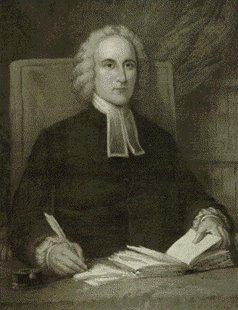
Excerpt from:
"Jesus Christ Gloriously Exalted Above All Evil in the Work of Redemption" - 1738
by Jonathan Edwards (1703-1758)
"For he must reign, till he hath put all enemies under his feet. The last enemy that shall be destroyed, is death." (1 Corinthians 15:25, 26)
II. Here is matter of exceeding great encouragement for all sinful miserable creatures in the world of mankind to come to Christ. For let them be as sinful as they will, and ever so miserable; Christ, in the work of redemption, is gloriously exalted above all their sin and misery.
How high soever their guilt has risen, though mountains have been heaping on mountains all the days of their lives, till the pile appears towering up to heaven, and above the very stars; yet Christ in the work of redemption appears gloriously exalted above all this height. — Though they are overwhelmed in a mighty deluge of woe and misery, a deluge that is not only above all their heads, but above the heads of the highest mountains, and they do not see how it is possible that they should escape; yet they have no reason to be discouraged from looking to Christ for help, who in the work of redemption, appears gloriously above the deluge of evil. Though they see dreadful corruption in their hearts, though their lusts appear like giants, or like the raging waves of the sea; yet they need not despair of help, but may look to Christ, who appears in the work of redemption, gloriously above all this corruption.
If they apprehend themselves to be miserable captives of Satan, and find him too strong an adversary for them, and the devil is often tempting and buffeting them, and triumphing over them with great cruelty; if it seems to them that the devil has swallowed them up, and his got full possession of them, as the whale had of Jonah; yet there is encouragement for them to look again, as Jonah did, towards God’s holy temple, and to trust in Christ for deliverance from Satan, who appears so gloriously exalted above him in the work of redemption.
If they are ready to sink with darkness and sorrows, distress of conscience, or those frowns of God upon them, so that God’s waves and billows seem to pass over them; yet they have encouragement enough to look to Christ for deliverance. These waves and billows have before exalted themselves against Christ, and he appeared to be infinitely above them. — And if they are afraid of death, if it looks exceeding terrible, as an enemy that would swallow them up; yet let them look to Christ who has appeared so gloriously above death, and their fears will turn into joy and triumph.
Sunday, April 09, 2006
Barna’s Wacky Stats.
According to a new report by George Barna, 45% of adults meet the criteria of being born again. That would mean that close to half of the adult population is born again. But don’t waive the victory flag just yet. A closer look at the criteria reveals something different, at least if you look at things from a biblical perspective.
Barna apparently has two categories of born again Christians. The first one involves a broad definition of those who have “made a personal commitment to Jesus Christ that is still important in their life today and who also indicated they believe that when they die they will go to Heaven because they had confessed their sins and had accepted Jesus Christ as their savior.” In this category, the respondents questioned did not describe themselves as born again, but merely met Barna’s criteria. They also did not meet the criteria to be called evangelicals. This category constitutes 36% of the adult population.
The other category is made up of evangelicals who meet the criteria mentioned above, plus the seven "core beliefs that mirror those taught in the Bible." These represent 9% of the adult public. The seven core beliefs are as follows:
Barna apparently has two categories of born again Christians. The first one involves a broad definition of those who have “made a personal commitment to Jesus Christ that is still important in their life today and who also indicated they believe that when they die they will go to Heaven because they had confessed their sins and had accepted Jesus Christ as their savior.” In this category, the respondents questioned did not describe themselves as born again, but merely met Barna’s criteria. They also did not meet the criteria to be called evangelicals. This category constitutes 36% of the adult population.
The other category is made up of evangelicals who meet the criteria mentioned above, plus the seven "core beliefs that mirror those taught in the Bible." These represent 9% of the adult public. The seven core beliefs are as follows:
- Saying that their faith is very important in their life today
- A belief in the responsibility to share their faith with non-Christians.
- Believing that Satan exists.
- Salvation is only through grace alone, not works.
- Believing in the sinless life of Jesus Christ.
- Affirming the accuracy of the Bible.
- Believing God is all-knowing, all-powerful, the perfect deity who created and rules the universe today.
After reading the article, I had to think to myself “Huh?” The second category more accurately reflects what it means to be born again. How can one claim to possess saving faith without affirming those seven core beliefs? Those are not optional, they are essential! So it seems that the reality is that only 9% are actually “born again” and possess legitimate saving faith.
This effort to make saving faith broad and inclusive is setting up people for deception. It was Jesus who said “Enter through the narrow gate; for the gate is wide and the way is broad that leads to destruction, and there are many who enter through it. For the gate is small and the way is narrow that leads to life, and there are few who find it.” (Matthew 7:13-14, NASB)
Monday, April 03, 2006
Christ Our Propitiation.
"4Surely our griefs He Himself bore,
And our sorrows He carried;
Yet we ourselves esteemed Him stricken,
Smitten of God, and afflicted.
5But He was pierced through for our transgressions,
He was crushed for our iniquities;
The chastening for our well-being fell upon Him,
And by His scourging we are healed.
6All of us like sheep have gone astray,
Each of us has turned to his own way;
But the LORD has caused the iniquity of us all
To fall on Him."
(Isaiah 53:4-6, NASB)
When Adam sinned, it brought devastating consequences for all of mankind. As a result of that sin, the perfect relationship that Adam and Eve had with God was severed. Adam was warned that partaking from the tree of the knowledge of good and evil would bring death.(Genesis 2:17; 3:19) This produced a curse that was transmitted to all of mankind.(Romans 5:12;6:23) We inherited Adam’s sin nature and we were under a death sentence, ready to receive the wrath of God.
As a result of our sinful disobedience, we were under the curse of the law. (Galatians 3:10, Deuteronomy 27:26) The law provided the means for defining the extent of our disobedience and was the grounds for our indictment. (Romans 3:19-20; 4:15; 5:13; 7:7) Scripture is replete with verses that indicate that we were in danger of the wrath of God.
John 3:36
Romans 1:18; Romans 2:5-6; 2:8
Ephesians 2:3; 5:6
Colossians 3:6
All of us are guilty of sin. (Romans 3:10-12) We were all deserving of just punishment for our sins, but God in His great mercy, provided the perfect sacrifice for sins, a propitiation for our sins. The term propitiation means to appease or pacify in the sense of allaying wrath or anger. Christ absorbed the wrath of God that was directed at us as a result of our sinfulness.
Romans 5:9-10
2 Corinthians 5:21
1 John 4:10
Scripture is quite clear on this matter and it is impossible to go very far in the Bible without running into verses that point out the substitutionary atonement of our Lord Jesus Christ. God offered his only Son in our place as a substitute to bear the punishment that we deserved.
"I have heard it said, "God didn’t die for frogs. So he was
responding to our value as humans." This turns grace on its head.
We are worse off than frogs. They have not sinned. They have not
rebelled and treated God with the contempt of being inconsequential
in their lives. God did not have to die for frogs. They
aren’t bad enough. We are. Our debt is so great, only a divine sacrifice
could pay it."
(John Piper, "The Passion of Jesus Christ", pg. 29)
Yet, sadly there are those who want to deny this and go to great lengths to deny and redefine the meaning of what took place on the cross. This is especially true in the emerging "church" movement. Observe the following quote by Brian McLaren in an interview with Leif Hanson:
McLaren: This is, one of the huge problems is the traditional understanding of hell. Because if the cross is in line with Jesus’ teaching then—I won’t say, the only, and I certainly won’t say even the primary—but a primary meaning of the cross is that the kingdom of God doesn’t come like the kingdoms of the this world, by inflicting violence and coercing people. But that the kingdom of God comes through suffering and willing, voluntary sacrifice. But in an ironic way, the doctrine of hell basically says, no, that that’s not really true. That in the end, God gets His way through coercion and violence and intimidation and domination, just like every other kingdom does. The cross isn’t the center then. The cross is almost a distraction and false advertising for God.
This is not the only incident of this philosophy. There is more. And this really is nothing new. I will be posting more on this subject soon.
And our sorrows He carried;
Yet we ourselves esteemed Him stricken,
Smitten of God, and afflicted.
5But He was pierced through for our transgressions,
He was crushed for our iniquities;
The chastening for our well-being fell upon Him,
And by His scourging we are healed.
6All of us like sheep have gone astray,
Each of us has turned to his own way;
But the LORD has caused the iniquity of us all
To fall on Him."
(Isaiah 53:4-6, NASB)
When Adam sinned, it brought devastating consequences for all of mankind. As a result of that sin, the perfect relationship that Adam and Eve had with God was severed. Adam was warned that partaking from the tree of the knowledge of good and evil would bring death.(Genesis 2:17; 3:19) This produced a curse that was transmitted to all of mankind.(Romans 5:12;6:23) We inherited Adam’s sin nature and we were under a death sentence, ready to receive the wrath of God.
As a result of our sinful disobedience, we were under the curse of the law. (Galatians 3:10, Deuteronomy 27:26) The law provided the means for defining the extent of our disobedience and was the grounds for our indictment. (Romans 3:19-20; 4:15; 5:13; 7:7) Scripture is replete with verses that indicate that we were in danger of the wrath of God.
John 3:36
Romans 1:18; Romans 2:5-6; 2:8
Ephesians 2:3; 5:6
Colossians 3:6
All of us are guilty of sin. (Romans 3:10-12) We were all deserving of just punishment for our sins, but God in His great mercy, provided the perfect sacrifice for sins, a propitiation for our sins. The term propitiation means to appease or pacify in the sense of allaying wrath or anger. Christ absorbed the wrath of God that was directed at us as a result of our sinfulness.
Romans 5:9-10
2 Corinthians 5:21
1 John 4:10
Scripture is quite clear on this matter and it is impossible to go very far in the Bible without running into verses that point out the substitutionary atonement of our Lord Jesus Christ. God offered his only Son in our place as a substitute to bear the punishment that we deserved.
"I have heard it said, "God didn’t die for frogs. So he was
responding to our value as humans." This turns grace on its head.
We are worse off than frogs. They have not sinned. They have not
rebelled and treated God with the contempt of being inconsequential
in their lives. God did not have to die for frogs. They
aren’t bad enough. We are. Our debt is so great, only a divine sacrifice
could pay it."
(John Piper, "The Passion of Jesus Christ", pg. 29)
Yet, sadly there are those who want to deny this and go to great lengths to deny and redefine the meaning of what took place on the cross. This is especially true in the emerging "church" movement. Observe the following quote by Brian McLaren in an interview with Leif Hanson:
McLaren: This is, one of the huge problems is the traditional understanding of hell. Because if the cross is in line with Jesus’ teaching then—I won’t say, the only, and I certainly won’t say even the primary—but a primary meaning of the cross is that the kingdom of God doesn’t come like the kingdoms of the this world, by inflicting violence and coercing people. But that the kingdom of God comes through suffering and willing, voluntary sacrifice. But in an ironic way, the doctrine of hell basically says, no, that that’s not really true. That in the end, God gets His way through coercion and violence and intimidation and domination, just like every other kingdom does. The cross isn’t the center then. The cross is almost a distraction and false advertising for God.
This is not the only incident of this philosophy. There is more. And this really is nothing new. I will be posting more on this subject soon.
Thursday, March 30, 2006
The Message of the Gospel.
Contemporary Evangelicalism in an attempt to make the gospel less threatening and more relevant has inadvertently muddled the message of the gospel. Evangelicalism is rapidly losing the ability to proclaim the message of saving faith with any clarity and boldness. Central to the gospel is the cross and it seems that there is a growing reluctance for the cross to be preached from the pulpits of our churches. To put it in a term that John MacArthur used as the title for his book, the church is “Ashamed of the Gospel”.
But the cross is central to the preaching of the gospel, and its emphasis in the presentation of the message of saving faith is crucial. However, the cross is offensive to the world. Scripture explicitly tells us that it is “foolishness to those who are perishing”. (1 Corinthians 1:18) Yet without the preaching of the cross, you really do not have the gospel at all. Any attempt at toning down or making it less offensive robs it of its power. The message of the cross is death, the death that Christ had to suffer to atone for the sins of man. Paul summarizes the key tenets of the gospel in 1 Corinthians 15:1-5.
“1Now I make known to you, brethren, the gospel which I preached to you, which also you received, in which also you stand,
2by which also you are saved, if you hold fast the word which I preached to you, unless you believed in vain.
3For I delivered to you as of first importance what I also received, that Christ died for our sins according to the Scriptures,
4and that He was buried, and that He was raised on the third day according to the Scriptures,
5and that He appeared to Cephas, then to the twelve.”
(1 Corinthians 15:1-5, NASB)
Central to the gospel is the fact that Christ died for our sins and was resurrected on the third day. Christ died for our sins, not to restore our self esteem or merely to give us purpose in our lives. He did not come to merely carry our burdens in life. He died to provide the perfect sacrifice for the atonement of our sins. To preach a gospel that deemphasizes the centrality of the cross essentially makes the message of saving faith powerless. We must understand that we are guilty of sinning against a just and holy God and that Christ suffered greatly in our place in order for us to enjoy a restored relationship with God the Father. To diminish the significance of the cross grieves God.
“The Great Commission is not a marketing manifesto...We gain nothing but God’s displeasure if we seek to remove the offense of the cross.”
(John MacArthur; “Ashamed of the Gospel: When the Church Becomes Like the World”, Pg. 18)
But even more disturbing are the latest attempts at re-thinking or to use a term gaining in popularity today, “re-imagining” the cross. I will be posting more on this topic in future posts.
But the cross is central to the preaching of the gospel, and its emphasis in the presentation of the message of saving faith is crucial. However, the cross is offensive to the world. Scripture explicitly tells us that it is “foolishness to those who are perishing”. (1 Corinthians 1:18) Yet without the preaching of the cross, you really do not have the gospel at all. Any attempt at toning down or making it less offensive robs it of its power. The message of the cross is death, the death that Christ had to suffer to atone for the sins of man. Paul summarizes the key tenets of the gospel in 1 Corinthians 15:1-5.
“1Now I make known to you, brethren, the gospel which I preached to you, which also you received, in which also you stand,
2by which also you are saved, if you hold fast the word which I preached to you, unless you believed in vain.
3For I delivered to you as of first importance what I also received, that Christ died for our sins according to the Scriptures,
4and that He was buried, and that He was raised on the third day according to the Scriptures,
5and that He appeared to Cephas, then to the twelve.”
(1 Corinthians 15:1-5, NASB)
Central to the gospel is the fact that Christ died for our sins and was resurrected on the third day. Christ died for our sins, not to restore our self esteem or merely to give us purpose in our lives. He did not come to merely carry our burdens in life. He died to provide the perfect sacrifice for the atonement of our sins. To preach a gospel that deemphasizes the centrality of the cross essentially makes the message of saving faith powerless. We must understand that we are guilty of sinning against a just and holy God and that Christ suffered greatly in our place in order for us to enjoy a restored relationship with God the Father. To diminish the significance of the cross grieves God.
“The Great Commission is not a marketing manifesto...We gain nothing but God’s displeasure if we seek to remove the offense of the cross.”
(John MacArthur; “Ashamed of the Gospel: When the Church Becomes Like the World”, Pg. 18)
But even more disturbing are the latest attempts at re-thinking or to use a term gaining in popularity today, “re-imagining” the cross. I will be posting more on this topic in future posts.
Sunday, March 19, 2006
Gilbert Bilezikian going the “emerging” route?
In a post on the Pyromaniacs this last weekend, Phil Johnson (the original “Pyromaniac”) had this link to an article interviewing Gilbert Bilezikian who was stating that the Western church is on the brink of extinction. Bilezikian was cofounder along with Bill Hybels of Willow Creek Community Church. He was stating that the biggest downfall was the lack of community among believers. According to Bilezikian, “After coming to Christ, our next step is to be involved in community.”
He goes on in the article to state that the church has been overtaken with individualism and the pursuit of material gain, breeding a sense of self-sufficiency. Having any meaningful family life is nearly impossible as everyone is pulled in different directions. He points to the issue of models of leadership that are more akin to that of a corporate CEO. These issues are among those that are contributing to making the church irrelevant.
Bilezikian then points to the fact that the New Testament church is to have a strong basis on community. He bemoans the fact that the church has become “institutionalized”. (He's beginning to sound like our “emerging” friends)
Bilezikian said that “The bane of the church is that it becomes worldly. Instead of imparting the Word and becoming an agent of change, it adopts the values of the world and integrates them into its structures and life."
But who encouraged the church in this direction? Isn’t the Willow Creek model just as he describes here? Isn’t he one of the “gurus” who helped formulate this strategy? Looking at the popular model that he helped create, I for one would not want to follow any newfangled concoction that he would recommend.
I would agree that the Bible certainly describes believers being in community with one another. I believe that this is clearly taught in Scripture. Believers looked out for the needs of one another and provided spiritual support and encouragement (Acts 2:42-47; Acts 4:32-37; Hebrews 10:24-25; Philippians 2:1-4)
But this community must be based on the truth of Scripture. The believers encouraged each other with the truth of God’s Word.
Bilezikian apparently is hopeful for the church, pointing “to a community movement which, he says, appeared at the end of the 20th century and has taken hold. These are churches in which lay people and clergy are raising basic questions about the identity of the Church, and about the definition of its workings.”
“It seems the Holy Spirit is operating a kind of quiet revival which is primarily aimed at recovering the dynamics of the Church of the Book of Acts, which results in renewed incentives for outreach in a pagan world.”
Gee, I wonder what “movement” he is referring to. He does not use the term “emerging”, but this certainly seems to be the movement he is describing. And it seems as if he is willing to jump from one popular bandwagon to another. I can appreciate the zeal to want to reach out to the pagan world, but we must be certain that this is carried out according to the truth of Scripture.
Since Bilezikian believes that “The bane of the church is that it becomes worldly" and "adopts the values of the world and integrates them into its structures and life“ , I wonder what he thinks the end result of this new movement will be?
It is good to raise questions about how the church should function, but let’s go back to Scripture and find out how the ministry should be carried out. Interpret the Bible in its normal historical-grammatical sense and find out what God’s definition of the church is.
I certainly appreciate the fact that the emerging church seeks to restore a sense of community in the church. If there is anything that is positive about the movement, the realization that community is important is a good thing. But deemphasizing or distorting the truth of Scripture creates a counterfeit sense of community, not a biblically based community. Long ago I felt that the church desperately needed a return to more of a sense of community. So many churches were just “program” driven. And I know of some churches that sensed that need as well. But they also understood that the community must center on biblical truth, not “deconstruct” it and refashion it according to our whims. So many of these churches set out to do just that; to create a community based on Scriptural accountability and discipleship according to the truth of Scripture.
As far as recovering the dynamics of the book of Acts, I wonder if the “emergent” types realize that those believers in Acts embraced the “apostles’ teaching” that was based on propositional truth that they so disdain? (Acts 2:42)
Yes, the church certainly needs to correct its thinking in certain areas, but there is no need to “reinvent” or “re-imagine” the church. And the last thing that we need is another popular movement to jump on board. It seems that everyone is desperately searching for that silver bullet to revitalize the church, eager to jump on the next purpose-driven frenzy. The fact is that there is no replacement for the solid teaching of God’s Word and a willingness to obey it. We don’t need another model to emulate or another way of doing church, but we just need to be the church according to God’s Word.
He goes on in the article to state that the church has been overtaken with individualism and the pursuit of material gain, breeding a sense of self-sufficiency. Having any meaningful family life is nearly impossible as everyone is pulled in different directions. He points to the issue of models of leadership that are more akin to that of a corporate CEO. These issues are among those that are contributing to making the church irrelevant.
Bilezikian then points to the fact that the New Testament church is to have a strong basis on community. He bemoans the fact that the church has become “institutionalized”. (He's beginning to sound like our “emerging” friends)
Bilezikian said that “The bane of the church is that it becomes worldly. Instead of imparting the Word and becoming an agent of change, it adopts the values of the world and integrates them into its structures and life."
But who encouraged the church in this direction? Isn’t the Willow Creek model just as he describes here? Isn’t he one of the “gurus” who helped formulate this strategy? Looking at the popular model that he helped create, I for one would not want to follow any newfangled concoction that he would recommend.
I would agree that the Bible certainly describes believers being in community with one another. I believe that this is clearly taught in Scripture. Believers looked out for the needs of one another and provided spiritual support and encouragement (Acts 2:42-47; Acts 4:32-37; Hebrews 10:24-25; Philippians 2:1-4)
But this community must be based on the truth of Scripture. The believers encouraged each other with the truth of God’s Word.
Bilezikian apparently is hopeful for the church, pointing “to a community movement which, he says, appeared at the end of the 20th century and has taken hold. These are churches in which lay people and clergy are raising basic questions about the identity of the Church, and about the definition of its workings.”
“It seems the Holy Spirit is operating a kind of quiet revival which is primarily aimed at recovering the dynamics of the Church of the Book of Acts, which results in renewed incentives for outreach in a pagan world.”
Gee, I wonder what “movement” he is referring to. He does not use the term “emerging”, but this certainly seems to be the movement he is describing. And it seems as if he is willing to jump from one popular bandwagon to another. I can appreciate the zeal to want to reach out to the pagan world, but we must be certain that this is carried out according to the truth of Scripture.
Since Bilezikian believes that “The bane of the church is that it becomes worldly" and "adopts the values of the world and integrates them into its structures and life“ , I wonder what he thinks the end result of this new movement will be?
It is good to raise questions about how the church should function, but let’s go back to Scripture and find out how the ministry should be carried out. Interpret the Bible in its normal historical-grammatical sense and find out what God’s definition of the church is.
I certainly appreciate the fact that the emerging church seeks to restore a sense of community in the church. If there is anything that is positive about the movement, the realization that community is important is a good thing. But deemphasizing or distorting the truth of Scripture creates a counterfeit sense of community, not a biblically based community. Long ago I felt that the church desperately needed a return to more of a sense of community. So many churches were just “program” driven. And I know of some churches that sensed that need as well. But they also understood that the community must center on biblical truth, not “deconstruct” it and refashion it according to our whims. So many of these churches set out to do just that; to create a community based on Scriptural accountability and discipleship according to the truth of Scripture.
As far as recovering the dynamics of the book of Acts, I wonder if the “emergent” types realize that those believers in Acts embraced the “apostles’ teaching” that was based on propositional truth that they so disdain? (Acts 2:42)
Yes, the church certainly needs to correct its thinking in certain areas, but there is no need to “reinvent” or “re-imagine” the church. And the last thing that we need is another popular movement to jump on board. It seems that everyone is desperately searching for that silver bullet to revitalize the church, eager to jump on the next purpose-driven frenzy. The fact is that there is no replacement for the solid teaching of God’s Word and a willingness to obey it. We don’t need another model to emulate or another way of doing church, but we just need to be the church according to God’s Word.
Thursday, March 09, 2006
Environmentalism and the Church.
Rick Warren and 85 other evangelical leaders are now part of a movement in evangelicalism to raise awareness of environmental concerns, particularly with global warming. Warren along with the other 85 leaders have released a statement entitled "Climate Change: An Evangelical Call to Action". However, 22 leaders in the National Association of Evangelicals (NAE) urged Ted Haggard, the president of that organization not to take an official position on global warming. Some of these leaders include Richard Land, Chuck Colson and David Barton. This is due to the skepticism as to the actual cause, extent and remedy for the problem. This skepticism is far reaching and includes scientists who recognize that average global temperatures have risen over the years, but are not unanimous in their conclusions that human generated CO2 emissions are the culprit. Scientists also do not agree on the extent of the effects and whether they will actually end up being catastrophic. Furthermore, there is doubt that cutting these CO2 emissions will be successful in reversing the warming trend. In fact, drastic measures may actually create economic harm and end up creating hardship for the poor.
What is amazing is the voracity with which people are willing to acknowledge that global warming is caused by human means. In fact, an MIT meteorologist compared it to a ‘religious belief’. Since people seem to automatically assume the consensus of all scientists on the issue, they simply believe it without actually trying to understand all of the facts.
He was not far off in his assessment. In fact, what is probably the most troubling is the actual religious implications attached to radical environmentalism. And now evangelicals are being enticed to jump on the bandwagon.
This push for the church to get involved with environmental concerns began some time ago. The idea was beginning to be promoted in the mid to late 1990s by men like Bill Easum. Easum is a church consultant who co-founded Easum, Bandy and Associates. In an article published in July 1996, Easum discusses the importance of ecology and how this will be “one of the major ministries for the first half of the twenty-first century.” He went on to say that “One of the key issues facing Christianity at the upcoming turn of the century is how to reach a generation turned off by Protestantism's dualistic approach to spirit and matter.” He also claims that it is this neglect of the environment that is causing the current generation to reject Christianity.
But what is most problematic is the tendency to promote a sort of pantheism. According to Easum, “Christianity must rediscover the interconnectedness and sacredness of all life if it is to reach them… Perhaps it's time for Protestants to think of the Earth as the "Third Sacrament."” Easum advocates raising the “care and feeding of the Earth…to the same stature as Baptism and Holy Communion.”
Easum goes on to say that “We would all be more respectful of the environment if we thought of it as a living organism instead of as just a planet on which life exists. I think the day will come when quantum physics will give us more than hints that everything, including the planet, is connected to the same life source.”
Easum further comments that “We could begin to put an end to the heresy that views some things as sacred and some things secular. Failure to understand the importance of this connection will be fatal to churches in the twenty-first century.”
While Bill Easum is not really officially classified as part of the “emerging” movement; some of the elements of postmodernism are permeating his philosophy. Environmentalism is high on the list of priorities in the emerging “church” movement. This is how postmodernism is making inroads into mainstream evangelicalism. This is why postmodernism really is not just an issue isolated to the emerging crowd, but has become very much a part of the culture today and is quickly seeping into evangelicalism.
This pantheistic tendency to make environmentalism synonymous with worship is rooted in paganism. Observe the following quote from a website promoting what is called scientific pantheism:
"When you look at the night sky or at the images of the Hubble Space Telescope, are you filled with feelings of awe and wonder at the overwhelming beauty and power of the universe?
When you are in the midst of nature, in a forest, by the sea, on a mountain peak - do you ever feel a sense of the sacred, like the feeling of being in a vast cathedral?
Do you believe that humans should be a part of Nature, rather than set above it?
If you can answer yes to all of these questions, then you have pantheistic leanings…
At the heart of pantheism is reverence of the universe as the ultimate focus of reverence, and for the natural earth as sacred.”
“Scientific Pantheism: Reverence of Nature and Cosmos”
by Paul Harrison
“A religion old or new, that stressed the magnificence of the universe as revealed by modern science, might be able to draw forth reserves of reverence and awe hardly tapped by the conventional faiths. Sooner or later, such a religion will emerge.”
Carl Sagan, Pale Blue Dot (1994)
It appears that we are well on our way towards the final false religious system described in Revelation 17 as “Mystery Babylon”.
The latest move by prominent Evangelicals is further evidence that we are moving further and further from biblical wisdom and understanding in the church. We are losing sight of the mission that the Lord has commanded us to carry out, becoming sidetracked by issues that the church is not really called to be directly involved in.
I am all for Christians being involved in civic duty and to be involved in their communities where they have the opportunity to be salt and light to the world. But I cannot see from Scripture where the church itself is called to become a global crusader to stomp out environmental problems and social ills. I further shudder at all the religious connotations associated with radical environmentalism and how this will influence the church.
Thursday, March 02, 2006
A False “Vision”?
I have wanted to comment further on some of the charges made against Calvinism. I commented last week on Ergun Caner’s comments left on the Founder’s blog slamming Cavinism. In that post I also mentioned how I listened to a sermon by a guest speaker for a Bible Conference at the church I attended in my home town, where he listed Calvinism as one of the beliefs (or as he put it, “visions”) that were problematic in the church today. The theme of the two sermons that he preached were on the church establishing a vision or focus for the ministry. The whole issue of listing Calvinism as a false “vision” really irritated me because it is just a display of ignorance of church history and ignorance of the text of Scripture. Not once did he explore the passages of Scripture that dealt with predestination and election, but loosely referred to the concepts in such a way as to present them in a negative light. What he discussed had more to do with hyper-Calvinism that is really only held by a relative minority, not orthodox or moderate Calvinism. He mentioned the common misperception that if you believe these doctrines, that there is no reason to be involved in evangelism. He also made some outlandish statements such as embracing Calvinism inevitably leads to postmillennialism and amillennialism, ultimately leading to political and social activism.
First of all, the charge that those who embrace reformed theology see no reason to evangelize is unwarranted. Charles Spurgeon, who adamantly embraced the tenets of Calvinism, also had a heart and compassion for the lost. “Oh, my brothers and sisters in Christ, if sinners will be damned, at least let them leap to hell over our bodies; and if they will perish, let them perish with our arms about their knees, imploring them to stay, and not madly to destroy themselves. If hell must be filled, at least let it be filled in the teeth of our exertions, and let not one go there unwarned and unprayed for.” (C.H. Spurgeon, “The Wailing of Risca”). Alistair Begg just went through a series on evangelism on his radio program “Truth for Life”, and he falls under the category of Reformed as well. I do not know of anyone personally who embraces Reformed theology and yet does not think evangelism is important.
Another outlandish statement was that the natural outgrowth of Calvinism is postmillennialism and amillennialism. Really? Yes, there are a number of people who do embrace those millennial views, but certainly not everyone does. In fact, while a large number do, there are plenty of others who embrace pre-millennialism including myself. And I am not about to go postmillennial or amillennial any time soon. How about John MacArthur? He is pre-millennial in his views of eschatology and yet embraces Calvinism. There are a wide variety of beliefs on eschatology in the Reformed camp. But I do not see how Calvinism ultimately leads to these millennial views or to any particular millennial view for that matter.
But the charge that Calvinism will ultimately lead you to become preoccupied with social reform and political activism is the one that really got me. Huh? Really? Yes, certainly there are some that are, but let’s look at evangelicalism today and see how many are preoccupied with political activism and social reform. Most of the key people involved in what we call political activism are certainly not associated with Reformed theology. Look at James Dobson for example. Or look at Rick Warren and how he is now preoccupied with environmental and social concerns. In fact, many of the men that I am familiar with who are Calvinists are opposed to political and social activism. John MacArthur has taught a series against political activism. Steve Camp has also spoken out against political activism as well. Many others in the reformed camp have also been outspoken against these things, recognizing that Scripture does not teach that the church’s primary mission is social reform. So this is another charge that is totally unwarranted.
Many of the things that were mentioned were things that I would agree are detrimental to the church. However, to list Calvinism as something that is harming the church was absolutely absurd. One of the greater issues contributing to the weaknesses in evangelicalism is the overt pragmatism that has become so prevalent today and is rooted in full-blown Arminianism. But nothing was mentioned about that. A careful study of church history reveals almost invariably that when the church to turns to a synergistic view of salvation, the church is generally characterized by a sharp spiritual decline. Look what happened during the period of time leading up to the Great Awakening. Arminianism had taken root in the church and the spiritual fervor of the people waned. It was the straight forward preaching of men like Jonathan Edwards and George Whitefield that helped ignite the fire of the Great Awakening. And they were Calvinists.
How about the wholesale departure from biblical preaching and teaching? What about the preoccupation with experience over truth? Those are the real hindrance to the mission of the church today. Political activism and preoccupation with social issues and reform are certainly detrimental, but to tie these things to Calvinism is ridiculous.
First of all, the charge that those who embrace reformed theology see no reason to evangelize is unwarranted. Charles Spurgeon, who adamantly embraced the tenets of Calvinism, also had a heart and compassion for the lost. “Oh, my brothers and sisters in Christ, if sinners will be damned, at least let them leap to hell over our bodies; and if they will perish, let them perish with our arms about their knees, imploring them to stay, and not madly to destroy themselves. If hell must be filled, at least let it be filled in the teeth of our exertions, and let not one go there unwarned and unprayed for.” (C.H. Spurgeon, “The Wailing of Risca”). Alistair Begg just went through a series on evangelism on his radio program “Truth for Life”, and he falls under the category of Reformed as well. I do not know of anyone personally who embraces Reformed theology and yet does not think evangelism is important.
Another outlandish statement was that the natural outgrowth of Calvinism is postmillennialism and amillennialism. Really? Yes, there are a number of people who do embrace those millennial views, but certainly not everyone does. In fact, while a large number do, there are plenty of others who embrace pre-millennialism including myself. And I am not about to go postmillennial or amillennial any time soon. How about John MacArthur? He is pre-millennial in his views of eschatology and yet embraces Calvinism. There are a wide variety of beliefs on eschatology in the Reformed camp. But I do not see how Calvinism ultimately leads to these millennial views or to any particular millennial view for that matter.
But the charge that Calvinism will ultimately lead you to become preoccupied with social reform and political activism is the one that really got me. Huh? Really? Yes, certainly there are some that are, but let’s look at evangelicalism today and see how many are preoccupied with political activism and social reform. Most of the key people involved in what we call political activism are certainly not associated with Reformed theology. Look at James Dobson for example. Or look at Rick Warren and how he is now preoccupied with environmental and social concerns. In fact, many of the men that I am familiar with who are Calvinists are opposed to political and social activism. John MacArthur has taught a series against political activism. Steve Camp has also spoken out against political activism as well. Many others in the reformed camp have also been outspoken against these things, recognizing that Scripture does not teach that the church’s primary mission is social reform. So this is another charge that is totally unwarranted.
Many of the things that were mentioned were things that I would agree are detrimental to the church. However, to list Calvinism as something that is harming the church was absolutely absurd. One of the greater issues contributing to the weaknesses in evangelicalism is the overt pragmatism that has become so prevalent today and is rooted in full-blown Arminianism. But nothing was mentioned about that. A careful study of church history reveals almost invariably that when the church to turns to a synergistic view of salvation, the church is generally characterized by a sharp spiritual decline. Look what happened during the period of time leading up to the Great Awakening. Arminianism had taken root in the church and the spiritual fervor of the people waned. It was the straight forward preaching of men like Jonathan Edwards and George Whitefield that helped ignite the fire of the Great Awakening. And they were Calvinists.
How about the wholesale departure from biblical preaching and teaching? What about the preoccupation with experience over truth? Those are the real hindrance to the mission of the church today. Political activism and preoccupation with social issues and reform are certainly detrimental, but to tie these things to Calvinism is ridiculous.
Sunday, February 26, 2006
R.C. Sproul Interview with John MacArthur.
I ran across this interview with John MacArthur and R.C. Sproul on the Ligonier Ministries website. The MP3 download is located here next to the last download on the page. They were discussing some of the subject matter for the upcoming Ligonier Ministries National Conference in Orlando. The theme this year is “The Bride of Christ”. John MacArthur is one of the speakers and one of his messages will be “The Shepherd and His Flock”.
Much of what was discussed had to do with the issues facing the church today, primarily with the diminishing adherence to the biblical role of the pastor and the importance of Biblical preaching.
The chief duty of the pastor is tending the flock which entails feeding the congregation employing the systematic study, teaching and preaching of Scripture with the central goal of spiritual nourishment of the church. This is clearly evident in the Bible especially in passages such as John 21:15-17, Acts 20:28, 1 Peter 5:2.
This is what causes the congregation to grow to be spiritually mature and develops discernment so the people are not lead astray by various forms of false teaching. If there is one primary contributing factor that has been instrumental in opening up the church today to be vulnerable to deceptive teaching, it is the failure of the church to follow a biblical form of pastoral leadership and church ministry. As Dr. MacArthur put it in the interview, there has been a “Proliferation of in a sense inadequate and unbiblical ministry in the so-called church”. Too much emphasis has been placed on “success” that is really based on a business model rather than what Scripture describes as biblical ministry. R.C. Sproul also mentioned his experience where he had a seminary professor actually tell the students that they should not preach beyond an eighth grade level, even if you have a congregation of primarily college educated people. This certainly defies Scripture by not providing the “full counsel” of God. The preaching should be centered on the true spiritual needs of the people, not their perceived “felt” needs. Many of the tactics used today as MacArthur points out, merely “manipulates a superficial response that creates an illusion that they have connected with God.” This further leads people down the path of deception.
What was really astonishing is the story John MacArthur told of a church in southern California, that was trying to elect a committee of church members that would be responsible for preparing the sermons for the pastor! Certainly describes what Paul warned Timothy about concerning those “wanting to have their ears tickled, they will accumulate for themselves teachers in accordance to their own desires,” (2 Timothy 4:3, NASB)
Faulty, unbiblical leadership is certainly treacherous to the church.
Much of what was discussed had to do with the issues facing the church today, primarily with the diminishing adherence to the biblical role of the pastor and the importance of Biblical preaching.
The chief duty of the pastor is tending the flock which entails feeding the congregation employing the systematic study, teaching and preaching of Scripture with the central goal of spiritual nourishment of the church. This is clearly evident in the Bible especially in passages such as John 21:15-17, Acts 20:28, 1 Peter 5:2.
This is what causes the congregation to grow to be spiritually mature and develops discernment so the people are not lead astray by various forms of false teaching. If there is one primary contributing factor that has been instrumental in opening up the church today to be vulnerable to deceptive teaching, it is the failure of the church to follow a biblical form of pastoral leadership and church ministry. As Dr. MacArthur put it in the interview, there has been a “Proliferation of in a sense inadequate and unbiblical ministry in the so-called church”. Too much emphasis has been placed on “success” that is really based on a business model rather than what Scripture describes as biblical ministry. R.C. Sproul also mentioned his experience where he had a seminary professor actually tell the students that they should not preach beyond an eighth grade level, even if you have a congregation of primarily college educated people. This certainly defies Scripture by not providing the “full counsel” of God. The preaching should be centered on the true spiritual needs of the people, not their perceived “felt” needs. Many of the tactics used today as MacArthur points out, merely “manipulates a superficial response that creates an illusion that they have connected with God.” This further leads people down the path of deception.
What was really astonishing is the story John MacArthur told of a church in southern California, that was trying to elect a committee of church members that would be responsible for preparing the sermons for the pastor! Certainly describes what Paul warned Timothy about concerning those “wanting to have their ears tickled, they will accumulate for themselves teachers in accordance to their own desires,” (2 Timothy 4:3, NASB)
Faulty, unbiblical leadership is certainly treacherous to the church.
Sunday, February 19, 2006
Fired Up About Some Things.
I have read some things this past week that really had me “fired up”, but I have not had much time to articulate my thoughts. I have a final exam coming up this next week and had a final project presentation this week for school, so I have not had much time to write any posts. But I did want to take some time to comment on Dr. Ergon Caner’s comments on the Founders blog this week.
In a post concerning the possible nomination of Johnny Hunt for the presidency of the Southern Baptist Convention, there were many comments left in response that expressed concern for Hunt’s anti-Calvinist bias. Then Dr. Caner left some inflammatory comments deriding Calvinism in general. I could hardly believe what I was reading!
For those who may not be familiar with Johnny Hunt’s attitude toward Calvinism, let me just summarize that he is adamantly opposed to Calvinism to the point that he apparently let one of his pastoral staff go due to that staff member’s adherence to Calvinistic theology! (Scroll through the comments and read the comment left by a former staff member, Scott) It could be that his election to the SBC may create such strife as to divide the convention over this issue.
It really bothers me when I see solid doctrine attacked, especially in a denomination that has made great strides over the years to purge itself from liberal theology. While there are further reforms that need to take place, I believe the SBC has come a long way and I would not want to see the convention derailed. I currently do not attend an SBC church. However, the church that I currently attend considered joining the SBC when we were just starting as a new church plant six years ago, and I would have backed the decision. The decision was made not to join the SBC at that time; however the pastoral staff indicated that they may reconsider the decision at a later date.
But the issue of bashing Calvinism really gets irritating. Most of the controversy centers on a misunderstanding of Reformed Theology. At the same time that I read Dr. Caner’s comments, I was listening to a sermon that I downloaded by a guest speaker from the church I attended in the town where I grew up. There were actually two sermons that this particular speaker preached at a Bible conference there. Most of what he said was good and right on target, but the second sermon really blew me away. In the second sermon, he cited three primary schools of thought that he claimed were aberrant thinking and were detrimental to the health of the church. Guess what the first one was. He listed Calvinism as the first one! It was all I could do to keep from yelling out loud, “NO, NO, NOOOO!!!” while pounding my fist on the desk. And, as you can imagine, he mentioned one of the common misconceptions that Calvinists are weak on evangelism due to a fatalistic view of predestination! Dr. Caner made the same charge of weak evangelism in his comments on Founders. It always seems that these misconceptions are due to a lack of understanding of Reformed theology and what people generally object too is usually an extreme view held by a relatively small minority of Calvinists. I too, am against what would be called hyper-Calvinism. But those who hold to a more orthodox Calvinism do not adhere to such extremes.
On the contrary, I can’t think of anything more detrimental to the health of the church today than the current barrage of pragmatism that for all essential purposes is rooted in full-blown Arminianism. I hope to comment more on this soon.
Well, that is all I have time to write for now. I just had to get that off of my chest! I feel better already :)
In a post concerning the possible nomination of Johnny Hunt for the presidency of the Southern Baptist Convention, there were many comments left in response that expressed concern for Hunt’s anti-Calvinist bias. Then Dr. Caner left some inflammatory comments deriding Calvinism in general. I could hardly believe what I was reading!
For those who may not be familiar with Johnny Hunt’s attitude toward Calvinism, let me just summarize that he is adamantly opposed to Calvinism to the point that he apparently let one of his pastoral staff go due to that staff member’s adherence to Calvinistic theology! (Scroll through the comments and read the comment left by a former staff member, Scott) It could be that his election to the SBC may create such strife as to divide the convention over this issue.
It really bothers me when I see solid doctrine attacked, especially in a denomination that has made great strides over the years to purge itself from liberal theology. While there are further reforms that need to take place, I believe the SBC has come a long way and I would not want to see the convention derailed. I currently do not attend an SBC church. However, the church that I currently attend considered joining the SBC when we were just starting as a new church plant six years ago, and I would have backed the decision. The decision was made not to join the SBC at that time; however the pastoral staff indicated that they may reconsider the decision at a later date.
But the issue of bashing Calvinism really gets irritating. Most of the controversy centers on a misunderstanding of Reformed Theology. At the same time that I read Dr. Caner’s comments, I was listening to a sermon that I downloaded by a guest speaker from the church I attended in the town where I grew up. There were actually two sermons that this particular speaker preached at a Bible conference there. Most of what he said was good and right on target, but the second sermon really blew me away. In the second sermon, he cited three primary schools of thought that he claimed were aberrant thinking and were detrimental to the health of the church. Guess what the first one was. He listed Calvinism as the first one! It was all I could do to keep from yelling out loud, “NO, NO, NOOOO!!!” while pounding my fist on the desk. And, as you can imagine, he mentioned one of the common misconceptions that Calvinists are weak on evangelism due to a fatalistic view of predestination! Dr. Caner made the same charge of weak evangelism in his comments on Founders. It always seems that these misconceptions are due to a lack of understanding of Reformed theology and what people generally object too is usually an extreme view held by a relatively small minority of Calvinists. I too, am against what would be called hyper-Calvinism. But those who hold to a more orthodox Calvinism do not adhere to such extremes.
On the contrary, I can’t think of anything more detrimental to the health of the church today than the current barrage of pragmatism that for all essential purposes is rooted in full-blown Arminianism. I hope to comment more on this soon.
Well, that is all I have time to write for now. I just had to get that off of my chest! I feel better already :)
Friday, February 10, 2006
Some Good Lectures on the EC.
 I ran across this link to a series of lectures from The Master’s Seminary on the emerging church movement over at EmergentNo. I listened to the one by John MacArthur and it was excellent. There are four audio files listed and apparently there are going to be a total of five. This is important folks because the emerging church is beginning to have a heavy influence on the evangelical church.
Jason Robertson had a great post of an article written by Travis Hilton, pastor at Parkview Baptist Church in Bluefield Virginia. The article is entitled “Becoming Conversant With The Emerging Church: A Review and Reflection”. It is a review with some additional reflections on
 the book by D.A. Carson. In the article, Hilton talks about the emerging church and its effect on the evangelical church, not just the churches officially labeled as “emerging”. I highly recommend reading the article.
But what amazes me is the lack of response Jason got after posting the article. I hope the lack of response was not due to lack of interest or the notion that it is not all that important. The last time I looked, I was the only one to comment on the topic. Yet the effect of the “emerging” church is permeating the greater evangelical community. And it is happening so subtly that the vast majority of people are unaware that it is taking place. Particularly with the rampant biblical illiteracy that exists in the church today. Even in my own church, most of the congregants probably have no idea what the emerging church is. Many ideas and philosophies are being cleverly introduced into the church without mentioning the term “emerging”. Of course, lately the term has popped up, but it has been utilized in such a way that people get the impression that it is something relatively benign. Our church is not totally off the wall and we do for the most part adhere to solid doctrine. We have a statement of faith that is one of the most complete and accurate that I have seen, but I am still concerned and I am being very watchful.
The church today is quickly losing her doctrinal foundation and we had better sit up and take notice.
Tuesday, February 07, 2006
Colson on Our Impaired Thinking Capacity.
I don’t always agree with some views of Chuck Colson, in particular his often overt ecumenism, but he often has some excellent insights and thoughtful articles that are well worth reading. Today’s article, “Musical Mush; Are We Impairing Our Capacity to Think?” is excellent. Colson keenly observes that “…much of the music being written for the Church today reflects an unfortunate trend—slipping across the line from worship to entertainment. Evangelicals are in danger of amusing ourselves to death, to borrow the title of the classic Neil Postman book.”
He goes further noting that many radio stations have begun replacing in-depth teaching programs in favor of entirely music formats, and observes “The great strength of radio, as with books, has been to present in-depth teaching that engages Christians cognitively. Unfortunately, thinking analytically is something Christians find increasingly difficult.”
Could it be that the church, as he puts it, is “blissfully amusing itself into irrelevance?”
He goes further noting that many radio stations have begun replacing in-depth teaching programs in favor of entirely music formats, and observes “The great strength of radio, as with books, has been to present in-depth teaching that engages Christians cognitively. Unfortunately, thinking analytically is something Christians find increasingly difficult.”
Could it be that the church, as he puts it, is “blissfully amusing itself into irrelevance?”
Thursday, February 02, 2006
Something to Think About.
I came across this post at the TMS Alumni blog that underscores the importance of evangelism. No, numbers are not all that important and there has been too much emphasis by the church growth movement on numbers as a measurement for success. However, a natural outcome of preaching the gospel is that people come to Christ and are added to the church. Without a doubt, discipleship and standing for the truth, taking care to accurately present the teaching of Scripture is of paramount importance. But if people are not added to the church, who are you going to disciple? What is going to happen to the spiritual fervor of the congregation? Typically, as the post points out, churches that participate little in active evangelism become self absorbed and turn inward. If this goes on for an extended period of time, the spiritual growth of the church eventually becomes hindered. In fact, neglecting evangelism has a tendency to cause membership to decline.
May we develop the heart for the lost that Spurgeon had.
“Oh, my brothers and sisters in Christ, if sinners will be damned, at least let them leap to hell over our bodies; and if they will perish, let them perish with our arms about their knees, imploring them to stay, and not madly to destroy themselves.”
C. H. Spurgeon, “The Wailing of Risca”
“But you, be sober in all things, endure hardship, do the work of an evangelist, fulfill your ministry.” (2 Timothy 4:5, NASB)
May we develop the heart for the lost that Spurgeon had.
“Oh, my brothers and sisters in Christ, if sinners will be damned, at least let them leap to hell over our bodies; and if they will perish, let them perish with our arms about their knees, imploring them to stay, and not madly to destroy themselves.”
C. H. Spurgeon, “The Wailing of Risca”
“But you, be sober in all things, endure hardship, do the work of an evangelist, fulfill your ministry.” (2 Timothy 4:5, NASB)
Wednesday, January 25, 2006
No! No Way!
That was my reaction this last Sunday morning as I walked toward the corner of the church foyer where we have on display some books for sale. From a distance I noticed a book with a blue cover that seemed to look familiar. As I got closer I began to recognize the cover as one I have seen in the Christian book store before, one written by Donald Miller, “Blue Like Jazz”. While walking toward the book shelf I began saying to myself – actually I was beginning to say it out loud – “No way! It can’t be”. Yep. There it was plain as day!
Now I have not had a chance to read this book, and doubt that I will – at least not cover to cover – for awhile. I already have a couple of other books I am struggling to finish reading, especially since I am in school and have limited time available. These are good books; books that I know are doctrinally sound and spiritually beneficial. But with time being limited, I have been struggling to complete them. When pressed for time and need to choose between time reading my Bible or reading a good book, I choose to read the Bible. It must take precedence. And I really do not like wasting time reading books that I suspect are filled with theological rubbish and have questionable benefit. But I fear I am going to need to take some time perusing through “Blue Like Jazz”, even if I do not read it cover to cover, just to get a closer look.
Fortunately, there are others who have read some of these books and have taken time to write reviews and give their perspective. One of the first places that I look to see if he has done a review on a particular book is Tim Challies. His reviews are a valuable resource and are generally from a solid biblical perspective.
In his review, Tim Challies admits that he already had doubts about the book due to an interview he read in a magazine, where Miller used such crude language that many words needed to be blanked out. That does not set too well with me either. Challies points out many of the problems with the book, but despite the shortcomings, he says he “enjoyed this book” more than he thought. To me, the negative aspects would have been enough of a turnoff. I guess I will find out once I peruse through the material myself.
Tim admits that Miller gets quite irritating as he bashes traditional Christianity. Politically, he generally lashes out at Republicans, degrading President Bush and very subtly praises Bill Clinton. Donald Miller apparently also expresses his enjoyment of Catholic Mass. His reported use of inappropriate words and comments is also disturbing.
In short, the book appears very disturbing in that the gospel message is generally muddled. According to Tim, Miller presents the false notion that the reason God saves us, is because we want to be rescued and that there is something in us that causes God to love us. But this is contrary to what the Bible teaches. Man is dead in his sins and God must first do a work in us in order to draw us to Himself.
After writing the review, Tim Challies admits that he became far less enthused about the book after he reflected on the contents. In the end, Tim is hesitant to recommend it to anyone. After reading his comments, I would strongly agree. Even if there may be some good points made in the book, it would take too much wading through the muddled theology to extract anything useful.
I am going to need to take some time to look over this book, but I think that I am going to come to basically the same conclusion. Perhaps I will be even more opposed to the material. If I am not mistaken, Brian McLaren endorses the book – on the back cover!
This is just another example of postmodern theological foolishness. Like much of the other postmodern material available, it just seems that these authors have an axe to grind with traditional churches and in particular, fundamentalist churches. I too have been extremely frustrated having attended an IFBx (Independent Fundamental Baptist Extreme) church. But to act like a rebellious adolescent and turn from the truth is not the answer. Scott Hill put it best when he described the emerging church movement as a bunch of Christian “hippies”.
Something tells me that I have many more battles coming up with the leadership in my church as they apparently continue to sip the postmodern “kool-aid”. Perhaps we should begin donning the nostalgic apparel of the 60s.
Now I wonder where I put my tie-died t-shirts…and those Birkenstocks.
Now I have not had a chance to read this book, and doubt that I will – at least not cover to cover – for awhile. I already have a couple of other books I am struggling to finish reading, especially since I am in school and have limited time available. These are good books; books that I know are doctrinally sound and spiritually beneficial. But with time being limited, I have been struggling to complete them. When pressed for time and need to choose between time reading my Bible or reading a good book, I choose to read the Bible. It must take precedence. And I really do not like wasting time reading books that I suspect are filled with theological rubbish and have questionable benefit. But I fear I am going to need to take some time perusing through “Blue Like Jazz”, even if I do not read it cover to cover, just to get a closer look.
Fortunately, there are others who have read some of these books and have taken time to write reviews and give their perspective. One of the first places that I look to see if he has done a review on a particular book is Tim Challies. His reviews are a valuable resource and are generally from a solid biblical perspective.
In his review, Tim Challies admits that he already had doubts about the book due to an interview he read in a magazine, where Miller used such crude language that many words needed to be blanked out. That does not set too well with me either. Challies points out many of the problems with the book, but despite the shortcomings, he says he “enjoyed this book” more than he thought. To me, the negative aspects would have been enough of a turnoff. I guess I will find out once I peruse through the material myself.
Tim admits that Miller gets quite irritating as he bashes traditional Christianity. Politically, he generally lashes out at Republicans, degrading President Bush and very subtly praises Bill Clinton. Donald Miller apparently also expresses his enjoyment of Catholic Mass. His reported use of inappropriate words and comments is also disturbing.
In short, the book appears very disturbing in that the gospel message is generally muddled. According to Tim, Miller presents the false notion that the reason God saves us, is because we want to be rescued and that there is something in us that causes God to love us. But this is contrary to what the Bible teaches. Man is dead in his sins and God must first do a work in us in order to draw us to Himself.
After writing the review, Tim Challies admits that he became far less enthused about the book after he reflected on the contents. In the end, Tim is hesitant to recommend it to anyone. After reading his comments, I would strongly agree. Even if there may be some good points made in the book, it would take too much wading through the muddled theology to extract anything useful.
I am going to need to take some time to look over this book, but I think that I am going to come to basically the same conclusion. Perhaps I will be even more opposed to the material. If I am not mistaken, Brian McLaren endorses the book – on the back cover!
This is just another example of postmodern theological foolishness. Like much of the other postmodern material available, it just seems that these authors have an axe to grind with traditional churches and in particular, fundamentalist churches. I too have been extremely frustrated having attended an IFBx (Independent Fundamental Baptist Extreme) church. But to act like a rebellious adolescent and turn from the truth is not the answer. Scott Hill put it best when he described the emerging church movement as a bunch of Christian “hippies”.
Something tells me that I have many more battles coming up with the leadership in my church as they apparently continue to sip the postmodern “kool-aid”. Perhaps we should begin donning the nostalgic apparel of the 60s.
Now I wonder where I put my tie-died t-shirts…and those Birkenstocks.
Thursday, January 19, 2006
Why We Must Battle for the Truth.

“Controversy is never a very happy element for the child of God: he would far rather be in communion with his Lord than be engaged in defending the faith, or in attacking error. But the soldier of Christ knows no choice in his Master's commands. He may feel it to be better for him to lie upon the bed of rest than to stand covered with the sweat and dust of battle; but, as a soldier, he has learned to obey, and the rule of his obedience is not his personal comfort, but his Lord's absolute command. The servant of God must endeavour to maintain all the truth which his Master has revealed to him, because, as a Christian soldier, this is part of his duty. But while he does so, he accords to others the liberty which he himself enjoys.”
—C. H. Spurgeon, in address at the Tabernacle, 1861.
In a recent post at Fide-O, Jason wrote about Mark Driscoll and how he distanced himself from the emergent movement due to their divergence from sound doctrine. I highly commend Mark for distancing himself from the extreme in the emerging movement and appreciate the fact that he had the courage to do so. You may want to check out Mark’s new blog where he explains his journey away from much of the emerging movement. His stand is certainly refreshing given the rising tide of those who are blindly following men like Brian McLaren to spiritual slaughter. I am not saying that there are not some things about his ministry that may concern me, but I appreciate his stand on doctrine. However, I am a little wary of his philosophy of polemics.
I discovered a post on another blog quoting Mark Driscoll on the subject of battling for the truth. Mark in addressing other churches in his Acts29 church planting ministry, warns about the danger he sees of becoming too polemic. Mark describes Spurgeon’s philosophy of only battling when someone gets in the way of the work. Spurgeon based this on the scene in Nehemiah 4:17-18 and is what inspired the title of his magazine, "The Sword and the Trowel". Mark seems to be attempting to make the point of not becoming engrossed in every controversy since this may occupy too much of our time and take away from the church’s mission to reach the lost.
While he does make a valid point and I somewhat agree with him, I would also argue that Spurgeon, if he were alive today, would have stood vehemently against the heresy being promulgated by men in much of the emerging church movement. He most certainly would have been quite outspoken. When men like McLaren and others spew their heresy and persuade others to follow, it does get in the way of the mission of the church.
Charles Haddon Spurgeon became embroiled in the midst of turmoil as he found it necessary to battle against the new theology of his day. He knew the importance of sound doctrine and understood the damaging effects of false teaching on the church. We too, must realize the serious ill effects of false doctrine and strive to fight against its influx into the church. Battling for the truth is not the most pleasant endeavor, but it is certainly necessary if we are to be true to Christ and His Word. This is a Scriptural command.
Paul warned the Ephesian elders in Acts 20:17-31 that there would be “savage wolves” that would devastate the flock of God. Paul went on to say that many of these false teachers would arise from their own ranks. These false teachers would draw away some of the disciples to follow them. The admonition was to be on the alert and do everything that they could to watch over and “shepherd” the flock of God. The biblical imagery of shepherding implies watching over, protecting from danger and making sure that the sheep have access to adequate nourishment. In fact, this is only one of many passages in the New Testament that deal with the need for confronting error and warning the people of God concerning false teaching.
This is why it is imperative to teach solid doctrine and instruct others on how to rightly handle the Word of God. When Paul addressed the elders in Ephesus, he could say with confidence that he did not withhold any truth that would be profitable (‘full counsel’, NKJV), thus making him innocent of the blood of any man. The charge of being guilty of the blood of men is described back in the Old Testament where the prophet Ezekiel (Ezekiel 3:17-21; 33:1-9) was commanded by God to act as a watchman and warn the people according to the Word given to him by God. If Ezekiel failed to warn the people, and they were destroyed as a result, God would hold Ezekiel responsible and he would be held guilty because of their fate. If Ezekiel faithfully proclaimed God’s truth and the people failed to heed the warning, Ezekiel was not responsible because he was faithful in proclaiming the warning. Paul was faithful in not holding back any truth. This is why it is wrong for the church to avoid teaching and preaching on any topics they think would be offensive to the people. Paul admonished Timothy to “preach the word; be ready in season and out of season” (2 Timothy 4:2-4), meaning whether the people were receptive or not.
Let’s pray that Mark Driscoll continues on the path of solid doctrine and surrounds himself with men who consistently uphold biblical truth. I also hope that he will take more opportunity to publicly refute the doctrinal error in the emerging church movement. Since he once followed the movement and has realized the error, I would think it would have a profound impact on those who hear his warning.
Friday, January 13, 2006
The Age of Misinformation.

Dr. Albert Mohler has an insightful article on his blog concerning the paradox of the lack of knowledge of important current events, news stories or any other important matters and the notion that we are living in the “Information Age”. Dr. Mohler refers to an article written by David Gelernter entitled "Misinformation Age: More Computers, Less Learning". Despite the proliferation of electronic gadgets and especially computers, it seems that young people are painfully uninformed about a multitude of subjects and issues. This is despite the round-the-clock availability of information available at any time at our fingertips. Undoubtedly, much of the problem lies with the willingness to know and discover information. Mindless tinkering with computers and technology does not alone lend itself to learning. They just become nothing more but toys.
I find it interesting that educators seem to tout computer use as if it is automatically conducive to learning, but that is simply not the case. Computers can be very useful and can be an incredible aid to productivity. The Internet provides a very useful venue for me for gathering information and learning, but that is due to the fact that I discipline myself to use it that way. However, the Internet is only one venue for my information gathering and learning. I also make extensive use of books and other printed media. The Internet just provides me with information very quickly. But receiving the information is only part of the process. One must also become skilled at interpreting and sorting through the information. This is true regardless of where you get the information – whether it is the Internet or books. It also requires discipline to take the time to process the information and think critically about what you are reading. A desire for learning needs to be cultivated. Computers are nothing more than another potential tool to use. But they can also be a source of distraction from learning. The basics of learning and critical thinking are the essential foundation that produces the process that fosters true knowledge.
This is what irritates me about our culture today. There really is no excuse for being uninformed.
But more importantly, how is this adversely affecting the church? Let’s put it this way, if multimedia and technology is not helping the culture acquire true knowledge and wisdom, then how is the influx of this same technology into the church going to further contribute to the “dumbing” down of Christianity? It is not that I am against the use of all multimedia and technology in the church by any means. It can be used as an effective tool, as long as it is not overused or misused. Multimedia does not lend itself to reflective thought. There is a reason God provided us with His written Word. Scripture is intended to be read, meditated on and internalized as the Holy Spirit brings to light God’s truth. This process is generally difficult if not impossible to achieve with a multimedia experience. The only effective means of equipping those in the church is through the consistent solid preaching and teaching of God's Word. It is the key element, not computers and multimedia. While computers can be a useful aid and certainly should be used, nothing can replace the proclamation of God's truth.
Thursday, January 05, 2006
Typical Attitudes.
It is interesting to note the attitude of those who hold to false teaching. Many exhibit a generally, unwholesome bad attitude. In a recent post on the “Texas Baptist Underground”, some commenter used profanity in response to a post that James Spurgeon had written. Another commenter who was also defending the legalistic LBT, left a blustery comment in their fury, which consisted of basically a run-on sentence with no punctuation that barely made any sense at all. On the other end of the spectrum, the postmodern emerging church crowd also displays much of the same behavior, replete with profanity and a rebellious spirit. Both are void of any Scriptural footing since they virtually ignore the authority of the Bible.
This seems to be par for the course with those who ignore Scripture as their final authority. Because their argumentation lacks any real authority, it is therefore void of any power and influence. Their only resort seems to be an attempt to bolster their position with profanity and personal attacks. But this really reveals the true heart of those involved in these tactics.
18"But the things that proceed out of the mouth come from the heart, and those defile the man. 19"For out of the heart come evil thoughts, murders, adulteries, fornications, thefts, false witness, slanders. 20"These are the things which defile the man; but to eat with unwashed hands does not defile the man." (Matthew 15:18-20, NASB)
Those who are led of the Spirit of God exhibit certain qualities called the “fruit of the Spirit”.
“22 But the fruit of the Spirit is love, joy, peace, longsuffering, kindness, goodness, faithfulness, 23 gentleness, self-control. Against such there is no law.” (Galatians 5:22-23, NKJV)
Those who are not led by the Holy Spirit lack this fruit.
“19 Now the works of the flesh are evident, which are: adultery, fornication, uncleanness, lewdness, 20 idolatry, sorcery, hatred, contentions, jealousies, outbursts of wrath, selfish ambitions, dissensions, heresies,” (Galatians 5:19-20, NKJV)
15"Beware of the false prophets, who come to you in sheep's clothing, but inwardly are ravenous wolves. 16"You will know them by their fruits. Grapes are not gathered from thorn bushes nor figs from thistles, are they? 17"So every good tree bears good fruit, but the bad tree bears bad fruit. 18"A good tree cannot produce bad fruit, nor can a bad tree produce good fruit. 19"Every tree that does not bear good fruit is cut down and thrown into the fire. 20"So then, you will know them by their fruits.”(Matthew 7:15-20, NASB)
The way people act reveal a lot about their heart and it often reveals the truth about the reality of their faith. False religion exemplifies man’s pride since it is composed of man’s philosophy and self-effort. Any critique of false beliefs strikes at man’s pride and likely causes a reaction according to the flesh.
This seems to be par for the course with those who ignore Scripture as their final authority. Because their argumentation lacks any real authority, it is therefore void of any power and influence. Their only resort seems to be an attempt to bolster their position with profanity and personal attacks. But this really reveals the true heart of those involved in these tactics.
18"But the things that proceed out of the mouth come from the heart, and those defile the man. 19"For out of the heart come evil thoughts, murders, adulteries, fornications, thefts, false witness, slanders. 20"These are the things which defile the man; but to eat with unwashed hands does not defile the man." (Matthew 15:18-20, NASB)
Those who are led of the Spirit of God exhibit certain qualities called the “fruit of the Spirit”.
“22 But the fruit of the Spirit is love, joy, peace, longsuffering, kindness, goodness, faithfulness, 23 gentleness, self-control. Against such there is no law.” (Galatians 5:22-23, NKJV)
Those who are not led by the Holy Spirit lack this fruit.
“19 Now the works of the flesh are evident, which are: adultery, fornication, uncleanness, lewdness, 20 idolatry, sorcery, hatred, contentions, jealousies, outbursts of wrath, selfish ambitions, dissensions, heresies,” (Galatians 5:19-20, NKJV)
15"Beware of the false prophets, who come to you in sheep's clothing, but inwardly are ravenous wolves. 16"You will know them by their fruits. Grapes are not gathered from thorn bushes nor figs from thistles, are they? 17"So every good tree bears good fruit, but the bad tree bears bad fruit. 18"A good tree cannot produce bad fruit, nor can a bad tree produce good fruit. 19"Every tree that does not bear good fruit is cut down and thrown into the fire. 20"So then, you will know them by their fruits.”(Matthew 7:15-20, NASB)
The way people act reveal a lot about their heart and it often reveals the truth about the reality of their faith. False religion exemplifies man’s pride since it is composed of man’s philosophy and self-effort. Any critique of false beliefs strikes at man’s pride and likely causes a reaction according to the flesh.
Subscribe to:
Posts (Atom)

